The government of Cyprus estimates the stray cat population at roughly one million. Activists say the number is higher. The International Cat Care report from 2025 acknowledged that no reliable census methodology has ever been applied to the island's cat population.
This is the first problem, and it is more important than it appears. Cyprus is attempting to manage a crisis it has never accurately measured. There is no baseline count. There is no geographic distribution map. There is no data on colony sizes, growth rates, or sterilization coverage by district. Every number cited in policy discussions is an estimate built on estimates.
The absence of data is not incidental. It is structural. And it guarantees that every intervention — no matter how well-funded — operates blind.
The Source of New Strays
The stray population in Cyprus is sustained by two pipelines. The first is reproduction among existing strays. The second is abandonment of owned cats.
The second pipeline is rarely discussed with the specificity it deserves. After the COVID-19 pandemic, large numbers of cats that had been adopted during lockdowns were abandoned when owners returned to pre-pandemic routines. This is documented across multiple reports. But abandonment is not limited to pandemic-era adoptions. It is a continuous process. People acquire kittens, fail to sterilize them, and release them when litters arrive or when circumstances change. There is no legal consequence and no traceability.
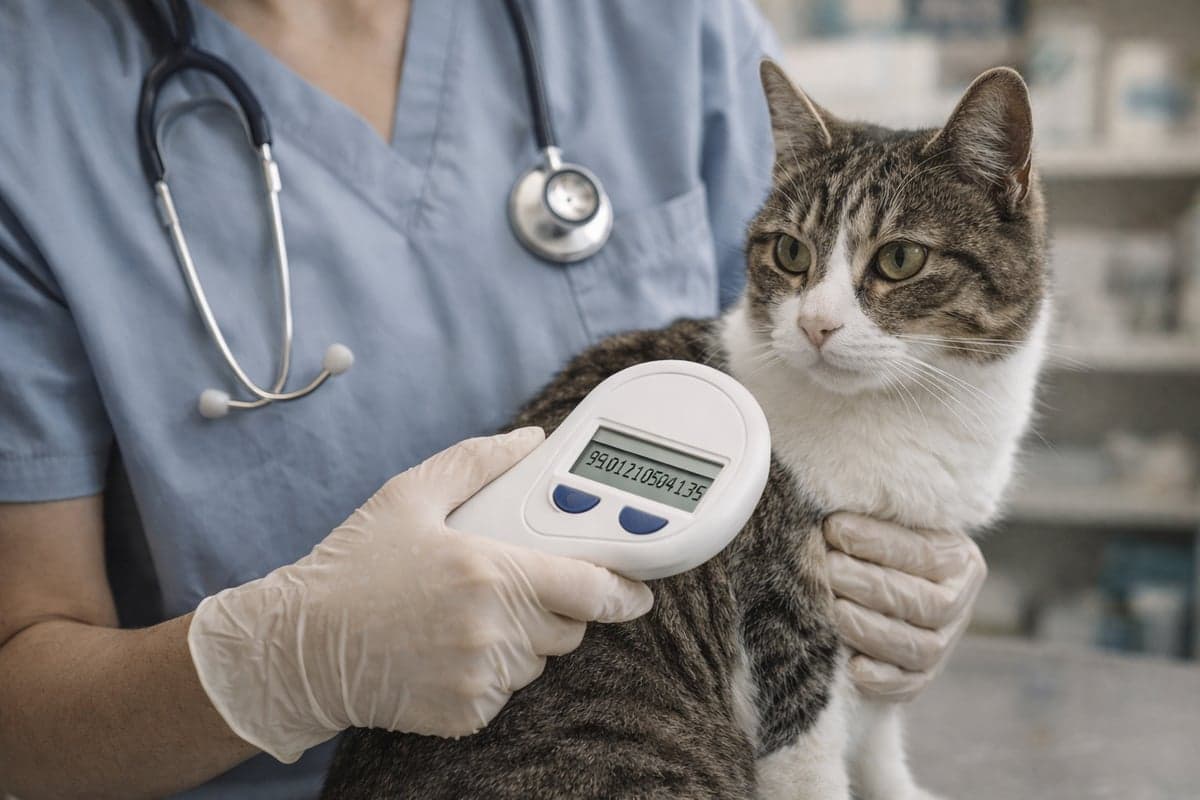
The reason there is no consequence is that there is no system for connecting a cat to an owner. Microchipping is technically required under EU regulation for cats traveling across borders, but there is no domestic requirement for microchipping owned cats within Cyprus, and no centralized registry that would allow an abandoned cat to be traced back to its owner.
What a National Registry Would Do
A mandatory microchip and registration system for all owned cats in Cyprus would accomplish four things that no other intervention can.
First, it would create traceability. When an abandoned cat is found, a microchip scan identifies the owner. This transforms abandonment from an invisible, consequence-free act into one with a paper trail. Enforcement follows naturally: fines for abandonment, liability for unsterilized animals, and a deterrent effect that reduces the inflow of new strays.
Second, it would generate the first accurate dataset on the owned cat population. If every owned cat is registered, the difference between the total estimated population and the registered population approximates the true stray count. This number — which does not currently exist — is essential for designing sterilization programs of the right scale.
Third, it would enable mandatory sterilization verification. If registration requires proof of sterilization or a sterilization bond (a refundable deposit returned upon proof of neutering), the reproductive output of the owned population drops to near zero. The owned cat population is the easier of the two pipelines to control, and it is currently completely uncontrolled.
Fourth, it would create a foundation for municipal accountability. With a registry, each municipality can be measured on sterilization rates, abandonment rates, and colony management. Without a registry, there is no metric, no benchmark, and no accountability.
How It Would Work
The implementation model is straightforward and has precedent in multiple EU member states.
All veterinary clinics on the island would be required to microchip and register any cat presented for treatment, vaccination, or sterilization. The chip number is linked to the owner's national ID in a centralized database managed by Veterinary Services.
A registration fee of €10 to €20 per cat funds the database and enforcement infrastructure. A sterilization bond of €50, refundable upon proof of neutering within six months, creates a financial incentive to sterilize.
All cats found without microchips in municipal areas are classified as unowned and enter the TNR pipeline. Cats found with microchips but without registered owners trigger an abandonment investigation.
Veterinary clinics become checkpoints. Every vaccination, every parasite treatment, every routine visit is an opportunity to verify registration and sterilization status. Compliance becomes woven into the existing veterinary infrastructure rather than requiring a new enforcement bureaucracy.
The Precedent
Belgium implemented a mandatory microchipping and registration system for all cats in 2017, with mandatory sterilization following in some regions. The system uses a central database (CatID) linked to veterinary practices. Compliance is enforced through veterinary checkpoints, and fines for unregistered cats create a financial incentive.
France introduced mandatory identification for all cats in 2012 through the I-CAD national database. Cats without identification cannot be legally sold or given away.
Neither Belgium nor France had a crisis of the scale Cyprus faces. But both demonstrate that the administrative infrastructure is proven, affordable, and enforceable within the EU regulatory framework. Cyprus would not be inventing a new system. It would be adopting one that already exists.
The Cost-Benefit
Microchipping costs approximately €15 to €30 per cat. If there are an estimated 200,000 to 300,000 owned cats in Cyprus — a rough estimate given the absence of data — the total microchipping cost would be €3 million to €9 million. Spread over a three-year implementation period and partially offset by registration fees and sterilization bonds, the annual net cost to the government is modest.
The return is a measurable reduction in the abandonment pipeline, a reliable dataset for population management, and a mechanism for municipal accountability that does not currently exist in any form.
Compare this to the current approach: €300,000 per year spent on sterilization with no data on the population being targeted, no mechanism to prevent new cats from entering the stray population, and no way to measure whether the spending is producing results.
Why It Has Not Happened
The most likely explanation is political. Requiring cat owners to microchip and register their animals is a mandate that affects a large portion of the electorate. It introduces a cost and an obligation. Politicians avoid mandates that create visible costs for constituents, even when the invisible costs of inaction are far greater.
The second explanation is institutional. Veterinary Services is focused on the sterilization program. The Deputy Ministry of Tourism is focused on hotel investment. Municipal governments are focused on complaint management. No single entity has the mandate to propose and implement a cross-cutting system like a national registry.
The third explanation is cultural. Cat ownership in Cyprus exists on a spectrum from fully indoor pets to semi-owned outdoor cats that are fed but not formally claimed. A registration system challenges the informal, ambiguous relationship many Cypriots have with the cats around them. Formalizing ownership means formalizing responsibility, and that is a cultural shift.
But cultural shifts are exactly what systemic crises require. The informal relationship between Cypriots and their cats is the same relationship that produces uncontrolled breeding, unchecked abandonment, and a stray population that outnumbers the human one.
The registry does not end that relationship. It structures it. And structure is what has been missing from every attempt to solve this crisis so far.
This is the fourth article in our five-part Solutions Series. Read the others: The Single Injection That Could End the Cyprus Cat Crisis, Cyprus Could Turn Its Cat Crisis Into a €100 Million Tourism Industry, The Cyprus Cat Crisis Will Never Be Solved Without Fixing the Bins, Eradicate by District, and A Million Cats and No Map.
If you are considering adopting a cat from Cyprus, see How International Pet Adoption Works from Cyprus to the UK and The Complete Guide to Adopting a Rescue Cat from Cyprus.
Tinies operates as a structured system for funding cat welfare — approximately 90 percent of marketplace booking commissions go directly to Gardens of St. Gertrude and other Cyprus sanctuaries. Structure works. Browse adoptable animals, find trusted pet care, or learn about our mission.
Related posts
 SOLUTIONS
The Single Injection That Could End the Cyprus Cat Crisis — And Why No One Is Talking About It
A gene therapy contraceptive developed by Harvard and the Cincinnati Zoo permanently sterilizes female cats with one injection. No surgery. No anes…
6 min read
Read → SOLUTIONS
Eradicate by District: What Infectious Disease Strategy Can Teach Cyprus About Its Cat Crisis
The World Health Organization did not eradicate smallpox by vaccinating randomly. It used ring containment — systematic, district-by-district elimi…
7 min read
Read → SOLUTIONS
A Million Cats and No Map: Why Cyprus Needs a Real-Time Feline Population Dashboard
Cyprus is managing a million-cat crisis with no census, no colony map, and no way to measure whether any intervention is working. Computer vision a…
8 min read
Read →