Cyprus sterilizes approximately 2,000 cats per year. The island's stray cat population is estimated at one million, with some activists placing the figure significantly higher. At the current rate, it would take five hundred years to sterilize the existing population — assuming no new cats were born in the interim.
The government recently tripled the sterilization budget to €300,000 annually. This was celebrated as a breakthrough. It is not. It is a rounding error applied to a crisis that compounds daily.
The math is not complicated. Surgical sterilization requires a trained veterinarian, anesthesia, a sterile facility, and post-operative recovery time. Each procedure costs between €50 and €120 depending on the clinic. At €300,000, the island can fund between 2,500 and 6,000 surgeries per year. Peer-reviewed population models consistently show that unless at least 70 percent of a feral cat population is sterilized within a narrow timeframe, the population does not decline. It stabilizes or rebounds. For Cyprus, 70 percent means sterilizing somewhere between 700,000 and 1.4 million cats. The current system cannot do this. It was never designed to do this.
But something exists that could.
What the Research Shows
In June 2023, a team led by David Pépin at Harvard and William Swanson at the Cincinnati Zoo published a study in Nature Communications describing a single-dose injectable contraceptive for female cats. The treatment uses an adeno-associated viral vector to deliver a feline anti-Müllerian hormone transgene directly into muscle tissue. One injection into the thigh causes the cat's muscle cells to produce elevated levels of AMH, a naturally occurring hormone that prevents ovulation.
The results were striking. Six treated female cats were housed with proven breeding males in two separate mating trials conducted eight and twenty months after the injection. None became pregnant. Three control cats became pregnant in both trials.
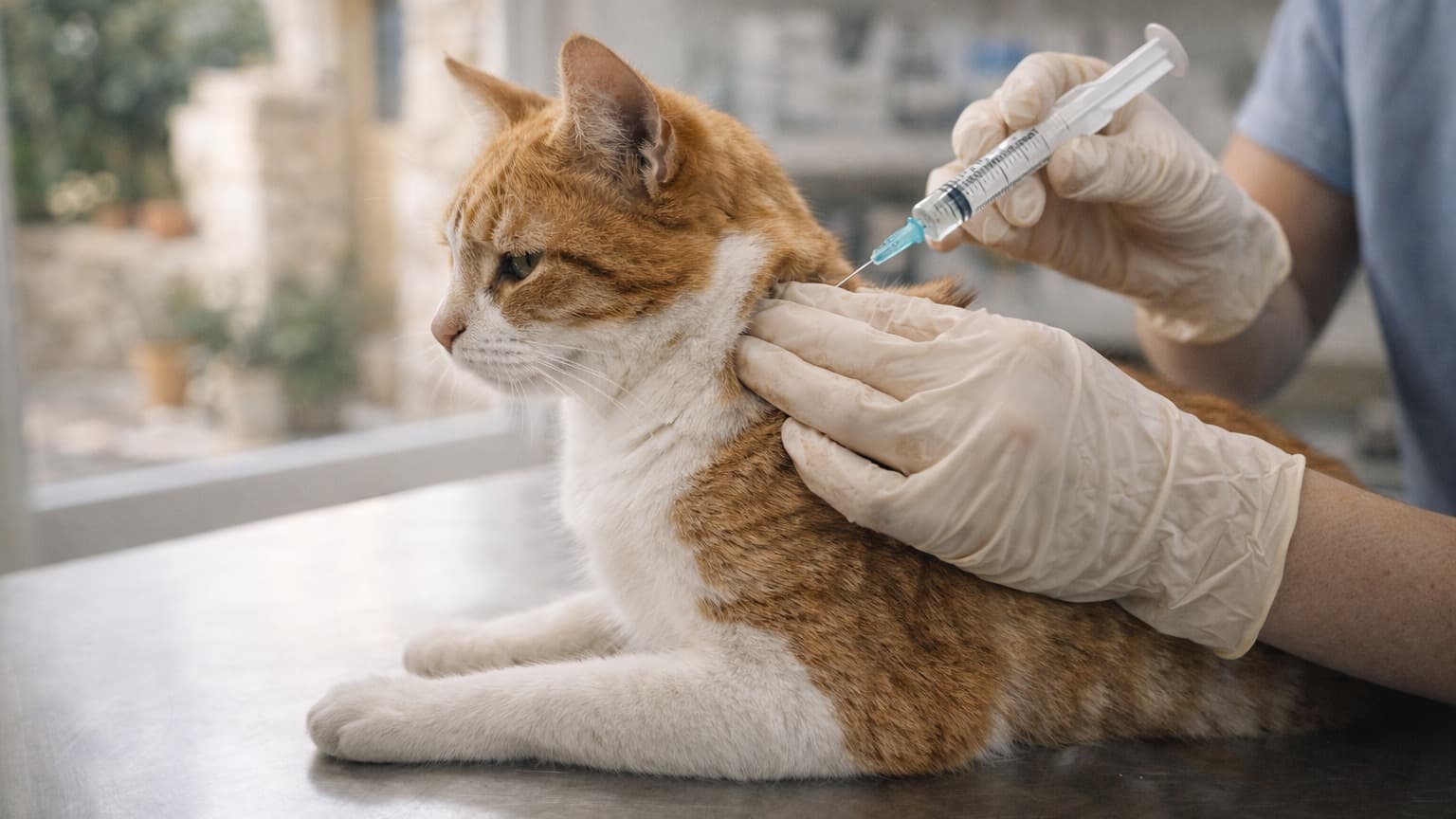
No surgery was involved. No anesthesia. No sterile operating environment. No recovery period. The injection takes seconds and can be administered by a trained technician rather than a veterinary surgeon.
The Michelson Found Animals Foundation, which funded the research, has offered a $25 million prize for the development of a single-treatment nonsurgical sterilization method for cats and dogs. The AMH gene therapy is the most promising candidate to date.
Why This Changes Everything for an Island
The bottleneck in Cyprus is not money alone. It is infrastructure. The island does not have enough veterinary surgeons to perform hundreds of thousands of surgeries. It does not have enough surgical facilities. It does not have enough post-operative capacity. Even if the budget were increased tenfold, the physical and human infrastructure could not deliver surgical sterilization at the scale required.
An injectable contraceptive administered by trained volunteers changes the equation entirely. The workflow becomes: trap, inject, release. No overnight holds. No surgical suites. No surgeon bottleneck. The throughput of a single team could increase from a few cats per day to dozens.
A 12-year controlled field study published in PNAS found that TNR programs only reduce populations when applied at high intensity across contiguous geographic areas. Fragmented, low-intensity efforts — which is exactly what Cyprus has been doing — produce minimal or no population reduction and can even be counterproductive by improving kitten survival rates without sufficiently reducing births.
An injectable contraceptive would allow Cyprus to run contiguous, high-intensity campaigns district by district, covering entire municipalities in weeks rather than years.
What Would It Take
The gene therapy contraceptive is not yet commercially available. It remains in the research phase, with larger trials needed to confirm long-term safety and efficacy. Regulatory approval through the European Medicines Agency would be required before deployment in the EU.
But Cyprus does not need to wait passively. The government could take three concrete steps immediately.
First, establish a formal partnership with the research team at Harvard and the Cincinnati Zoo to participate in expanded field trials. Cyprus offers the ideal testing environment: a bounded island geography, an enormous and well-documented feral population, and a government that has publicly acknowledged the crisis.
Second, allocate a portion of the €300,000 annual sterilization budget toward co-funding clinical trials on the island. Even €50,000 directed toward field validation would position Cyprus as a global leader in humane feral cat management rather than a cautionary tale.
Third, begin training a volunteer workforce in trap-and-inject protocols now, so that when the contraceptive becomes available, the human infrastructure is ready to deploy at scale.
Why This Should Matter to Everyone
The Cyprus cat crisis is not unique. It is a concentrated version of a global problem. An estimated 600 million cats live without permanent homes worldwide. Approximately 80 percent of the global cat population is free-roaming. Surgical sterilization has been the primary tool for decades and has not solved the problem anywhere at national scale.
If a single-injection contraceptive can be proven safe, effective, and affordable, it changes feral cat management globally. Cyprus, by virtue of its island geography and the severity of its crisis, is the natural proving ground.
The question is whether anyone on the island is paying attention.
The sterilization budget was tripled and declared a victory. Meanwhile, at Harvard and the Cincinnati Zoo, a team has developed the tool that could actually end this. It takes one injection. It costs a fraction of surgery. It does not require a veterinarian. And it works.
The crisis is not unsolvable. It is unsolved because the most promising solution has not been pursued.
This is the first article in our five-part Solutions Series. Read the others: Cyprus Could Turn Its Cat Crisis Into a €100 Million Tourism Industry, The Cyprus Cat Crisis Will Never Be Solved Without Fixing the Bins, What If Every Cat in Cyprus Had an Identity?, Eradicate by District, and A Million Cats and No Map.
For background on the crisis itself, see The Stray Cat Crisis in Cyprus and Why Cyprus Has So Many Stray Cats.
Tinies is a pet services marketplace where approximately 90 percent of booking commissions fund Gardens of St. Gertrude and other cat sanctuaries in Cyprus. Every booking helps. Browse adoptable animals, find trusted pet care, or learn how it works.
Related posts
 SOLUTIONS
What If Every Cat in Cyprus Had an Identity? The Case for a National Feline Registry
Cyprus cannot manage what it cannot count. A mandatory microchip registry for all owned cats — enforced through veterinary checkpoints — would clos…
7 min read
Read → SOLUTIONS
Eradicate by District: What Infectious Disease Strategy Can Teach Cyprus About Its Cat Crisis
The World Health Organization did not eradicate smallpox by vaccinating randomly. It used ring containment — systematic, district-by-district elimi…
7 min read
Read → SOLUTIONS
A Million Cats and No Map: Why Cyprus Needs a Real-Time Feline Population Dashboard
Cyprus is managing a million-cat crisis with no census, no colony map, and no way to measure whether any intervention is working. Computer vision a…
8 min read
Read →