This is the post that every startup founder is advised not to write.
The conventional wisdom is that you do not talk about money in terms of what you don't want. You don't tell investors you're not trying to maximize returns. You don't tell the market you're not optimizing for growth. You don't draw a line between your platform and the standard playbook in a way that could be read as leaving money on the table.
The conventional wisdom is wrong — at least for this platform, built for this reason, by someone who has spent fifteen years watching what happens when the incentive structures of a business are misaligned with its stated mission.
What "Not Trying to Get Rich" Actually Means
It does not mean we are not building a real business. Tinies has a booking commission. It has a payment flow. It has a revenue model. These are not incidental features — they are the mechanism by which animals get fed, sanctuaries stay open, and the sitters who make this platform function get paid fairly.
What it means is that the revenue model was designed around a question that most platforms never ask: what is this money for?
Approximately 90% of Tinies' booking commission goes directly to Gardens of St. Gertrude and partner sanctuaries—the core idea behind the 90% model. That number was not arrived at by working backward from a target margin. It was arrived at by looking at what the sanctuaries actually need and building a commission structure that could reliably deliver it at scale.
The platform is sustainable. The mission is the reason for the sustainability, not the thing that gets funded after the real business is profitable enough.
Where This Came From
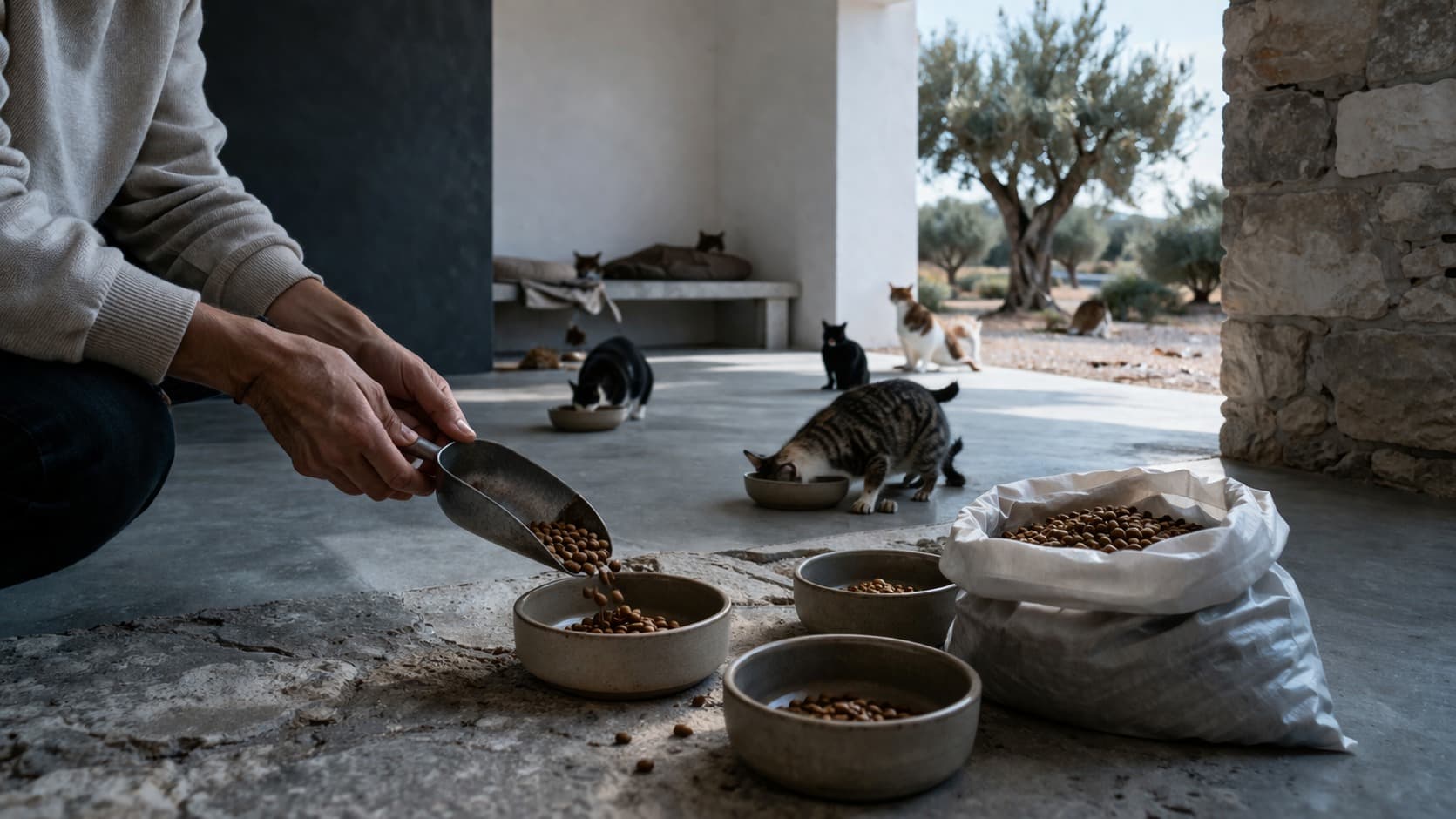
Gardens of St. Gertrude currently cares for 92 cats in Parekklisia, Cyprus. I founded it. I run it. I know exactly what it costs to keep an animal alive and healthy — in food, in veterinary care, in the human hours that go into a sanctuary that operates without the kind of funding that larger organizations take for granted.
I also know what it costs when that funding isn't there. Animals that could be saved aren't. Adoptions that could happen don't, because there's no infrastructure to move animals across borders at the speed and scale the situation requires. Sitters and welfare workers who do this because they love it burn out because the financial precarity of the work is unsustainable.
Tinies exists because I was looking at all of that from the inside and asking what a platform built to fix it would actually look like. Not what a platform optimized for a Series B would look like — what would actually fix it.
The People Who Take Care of Animals
There is a category of person who takes care of animals professionally — as a sitter, a walker, a boarding host, a sanctuary worker, a rescue coordinator — who is structurally undervalued by every existing platform and institution in the space. We've seen this repeatedly with failing pet care marketplaces that prioritize extraction over partnership.
They are not undervalued because the work is unskilled. Anyone who has managed the care of multiple animals simultaneously, navigated a pet health emergency, or coordinated an international adoption across three countries and two languages knows this is not unskilled work. They are undervalued because the platforms they depend on are designed to treat them as interchangeable supply, because the commission structures extract maximum margin from their labor, and because when something goes wrong they are usually the ones absorbing the cost.
Tinies was built with these people in mind — not as a supplier relationship to be optimized, but as the core constituency the platform exists to serve. Fair pay, transparent processes, real protections, and a platform whose financial success is directly tied to their success are not perks. They are the architecture.
Money Is How Things Happen
There is a version of this post that romanticizes low margins and nonprofit models and the virtue of operating outside the market. That is not this post.
Money is how sanctuaries stay open. It is how animals get transported across borders. It is how sitters build sustainable businesses instead of burning out after two years. It is how the infrastructure for international pet adoption gets built and maintained and improved. It is how the organizations doing the hardest welfare work have the surge capacity to respond when displacement crises happen.
The goal is not to minimize revenue. The goal is to route it correctly — to make sure that the financial success of this platform is inseparable from the welfare outcomes it was built to produce. A thriving Tinies is not a platform that has extracted maximum margin from sitters and users. It is a platform that has generated enough transaction volume to meaningfully fund the sanctuaries, the sitters, and the adoption infrastructure that the animals and the people who care for them actually need.
Those are not the same company. Only one of them is worth building.
What This Means for You
If you book a pet care service through Tinies, the transaction you complete does something beyond the booking. It funds a sanctuary. It supports a sitter who is treated as a partner rather than a contractor to be managed. It contributes to an adoption infrastructure that moves animals from crisis-adjacent situations to stable homes.
If you are a sitter looking for a platform that will not deactivate your account without notice, reverse your earnings without explanation, or route every dispute against you because you are the more replaceable party — Tinies was built for you.
If you are an investor who wants to back a platform where financial sustainability and mission are structurally the same thing — this is that platform, and the conversation is open.
If you are a sanctuary or rescue organization looking for a platform partner that routes revenue to welfare organizations rather than extracting from them — reach out.
We are not trying to get rich.
We are trying to make sure there is enough money, flowing to the right places, to take care of the animals. That turns out to require building a real business. We built one.
Karen Pendergrass is the founder of Tinies and Gardens of St. Gertrude, a cat sanctuary in Parekklisia, Cyprus. She is also the founder and CEO of the Paleo Foundation and Microbiome Medicine.
Related posts
 PET CARE
Why We'd Rather Have Investors Who Actually Like Dogs
In 2021, Rover went public via SPAC at a valuation of $1.35 billion. In 2023, Blackstone — the private equity firm with $1 trillion in assets under…
6 min read
Read → ADOPTION
War Doesn't Just Displace People. It Abandons Animals.
When a family flees, the question of what to do with the dog is not a small one.
5 min read
Read → PET CARE
The Map of Countries That Rover Forgot
Rover operates in the United States, Canada, the United Kingdom, Germany, the Netherlands, Norway, Sweden, Denmark, Finland, Austria, Switzerland, …
6 min read
Read →