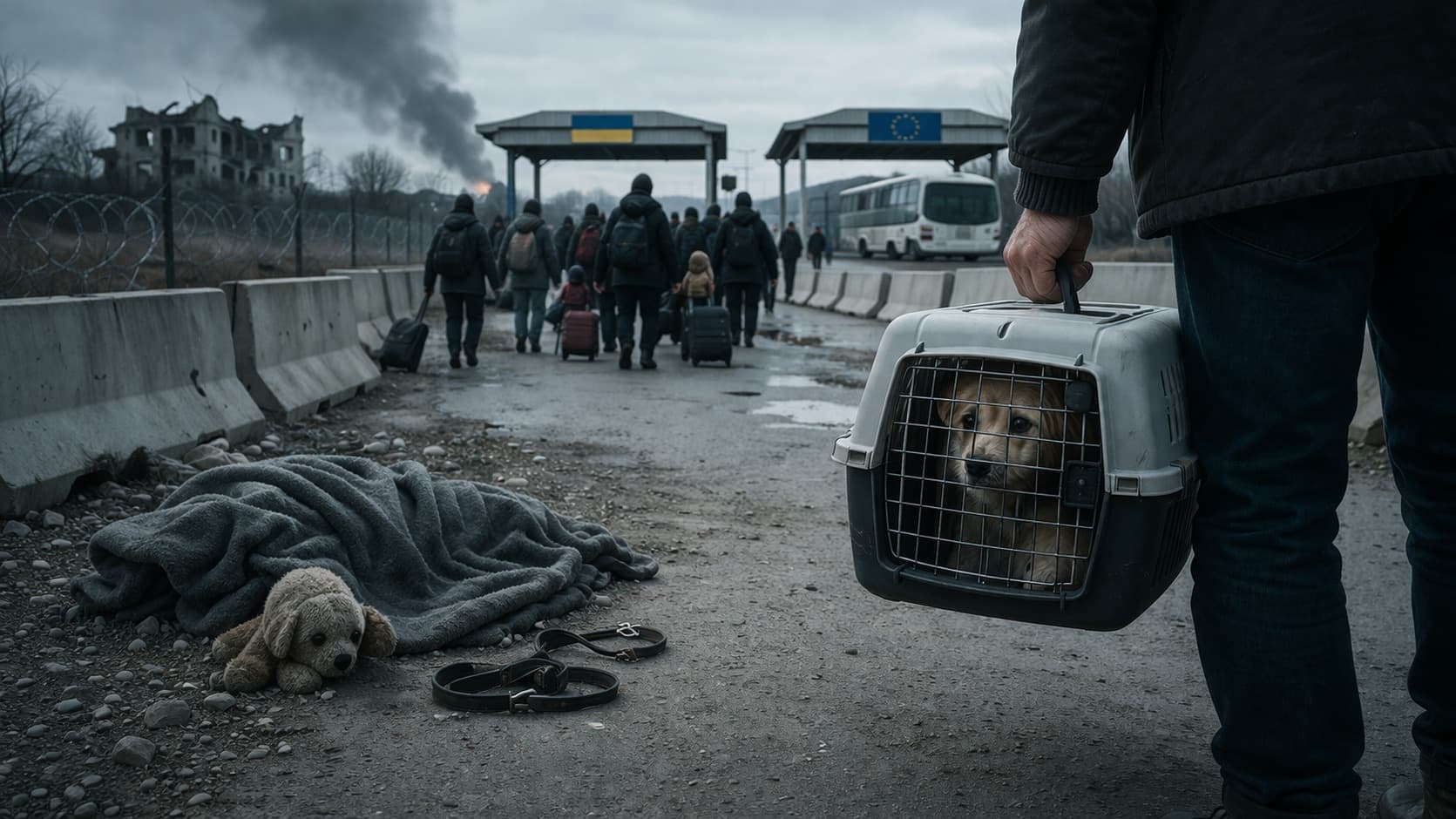
When a family flees, the question of what to do with the dog is not a small one.
It does not feel small when you are standing at a border crossing that does not permit animals. It does not feel small when the evacuation bus has no room, when the shelter has a no-pets policy, when the rescue organization is overwhelmed and the international adoption waitlist is months long. It does not feel small when you have to make a decision in minutes that you will think about for the rest of your life.
This is not a hypothetical. It has happened to hundreds of thousands of families in Ukraine, Lebanon, Gaza, and Syria. It is happening now. And the infrastructure that should exist to help — coordinated, cross-border, sanctuary-linked, fast enough to be useful in a crisis — largely does not exist.
This is part of why Tinies was built.
What the Data Shows
During the first months of the war in Ukraine, animal welfare organizations reported being overwhelmed with surrendered and abandoned pets at a scale they had never encountered. Shelters across Poland, Romania, and Hungary — the primary refugee corridors — filled within days. Rescue organizations scrambled to coordinate international transport with almost no formal infrastructure to support it.
Similar patterns have played out in Lebanon across multiple displacement events, and again following the escalation of conflict in Gaza. Families who evacuate face legal, logistical, and financial barriers to pet transport that are effectively insurmountable in crisis conditions. Animals are left behind. Some are taken in by neighbors. Many are not.
The organizations doing the most meaningful work in these situations — cross-border transport coordinators, sanctuary networks, emergency fostering programs — operate largely through informal networks, personal contacts, and improvised logistics. There is no marketplace. There is no vetted sitter network that activates during displacement. There is no adoption pipeline designed to move animals from crisis zones to stable homes internationally at speed.
Living Near the Edge of It
Tinies was founded in Cyprus — ten minutes from RAF Akrotiri, one of the largest British military installations in the Mediterranean, and directly adjacent to a region that has experienced conflict-driven displacement across multiple generations.
This is not incidental context. It shaped the platform's architecture.
International adoption infrastructure was not added to Tinies as a feature after the core marketplace was built. It was part of the foundation — because the founder lives in a place where the distance between a stable life and a displacement crisis is not abstract. Cyprus has absorbed waves of refugees. The region's stray animal population reflects decades of human displacement. Gardens of St. Gertrude, the sanctuary that Tinies funds, exists partly because animals do not survive instability without infrastructure behind them.
What a Marketplace Can and Cannot Do
We are not going to overstate this.
A pet services marketplace does not stop wars. It does not solve the legal complexity of cross-border animal transport in active conflict zones. It does not replace the work of the rescue organizations and volunteers who do the hardest parts of this work on the ground.
What it can do:
It can build and maintain the adoption pipeline infrastructure that allows animals to move from crisis-adjacent sanctuaries to stable homes internationally — not just during emergencies, but continuously, so the capacity exists when it is needed. It can route platform revenue to the sanctuary and rescue organizations that are doing the work, creating a sustainable funding model that does not depend entirely on donation cycles. It can create a vetted sitter and foster network that activates faster than informal systems when displacement events occur. It can make the normal, everyday business of pet care — sitting, walking, boarding, home visits — generate the financial foundation that animal welfare organizations need to maintain surge capacity.
This is what Tinies is built to do. Not as a crisis response tool, but as persistent infrastructure that makes the response faster and better resourced when crises happen.
The Question Nobody in Pet Services Is Asking
The major pet care platforms — Rover, Wag, Fetch — are built around a stable, suburban, primarily American user. The implicit assumption is that pet ownership happens in a context of relative safety and permanence: you have a home, you travel occasionally, you need someone to watch your dog.
That assumption excludes most of the world.
It excludes the expat in Dubai whose assignment ends unexpectedly and needs to rehome her cat before her visa expires. It excludes the family in Beirut whose evacuation plan has no room for their dog. It excludes the sanctuary in Cyprus that has 92 cats and a funding gap that a platform revenue share could meaningfully close.
These are not edge cases. They are the majority of the global pet ownership experience, and no major platform is building for them.
What You Can Do
If you are in a position to adopt an animal with an international background — from Cyprus, from Greece, from the broader Mediterranean region — our adoption platform connects you directly with sanctuary-vetted animals and handles the coordination infrastructure.
If you run a rescue organization or sanctuary and want to discuss a platform partnership, contact us. Tinies is designed to route revenue to organizations doing this work, not to compete with them.
If you are a pet owner who wants your everyday spending on pet care to fund something beyond the transaction, that is exactly what Tinies does.
The animals abandoned by conflict do not have a lobby. They do not have a marketing budget. They have sanctuaries, rescue organizations, and occasionally a platform that was built with them in mind from the beginning.
Tinies is a pet services marketplace and international animal adoption platform based in Cyprus. A majority of platform revenue supports Gardens of St. Gertrude and partner sanctuaries across the region.
Related posts
 PET CARE
We Are Not Trying to Get Rich. We Are Trying to Take Care of Animals.
This is the post that every startup founder is advised not to write. The conventional wisdom is that you do not talk about money in terms of what …
6 min read
Read → PET CARE
Why We'd Rather Have Investors Who Actually Like Dogs
In 2021, Rover went public via SPAC at a valuation of $1.35 billion. In 2023, Blackstone — the private equity firm with $1 trillion in assets under…
6 min read
Read → PET CARE
The Map of Countries That Rover Forgot
Rover operates in the United States, Canada, the United Kingdom, Germany, the Netherlands, Norway, Sweden, Denmark, Finland, Austria, Switzerland, …
6 min read
Read →