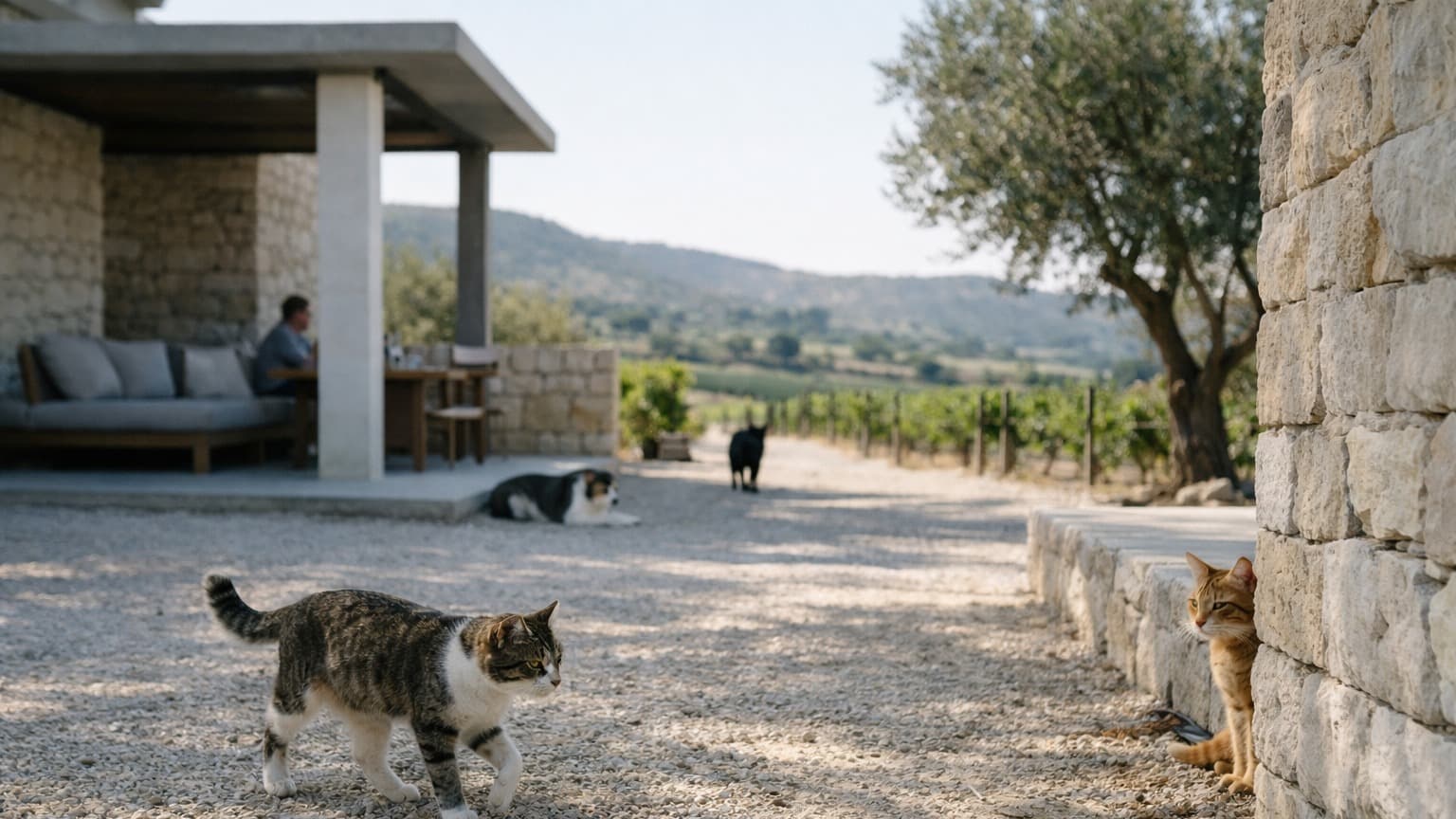
Here is a scenario that is playing out across rural Cyprus right now, in slow motion, with no particular drama attached to it.
A family ran a small vineyard for thirty years. The parents are retiring. The children moved to Nicosia or London or Thessaloniki. Nobody in the next generation wants to run a vineyard in the Troodos foothills. The property — fenced, gated, with a small tasting room, outbuildings, and several hectares of productive land — goes on the market at a price that reflects the scarcity of buyers, not the value of the asset.
This is not an unusual story. It is happening across the Limassol district, the Paphos hinterland, and the villages that ring the Troodos range. It is part of a broader demographic shift in rural Cyprus that has been documented and discussed for years without producing a coherent policy response.
It is also, from a different angle, an opportunity.
What a sanctuary acquisition actually looks like
The mechanics are more straightforward than they sound. A distressed rural property with existing infrastructure — buildings, fencing, outbuildings, water access — is acquired through a conventional business purchase. The financing instrument is a business loan or agricultural property mortgage, both of which exist in Cyprus and across the EU for exactly this kind of rural asset transfer.
The new operator runs the property as a working business. Wine production, agrotourism, accommodation, craft production — whatever the property was doing before, or a variation of it suited to the new operator's skills. The cats live there. Their welfare is funded by a defined percentage of revenue that is written into the operating structure from day one, not added later as a gesture of goodwill.
The cats live there. Their welfare is not a charitable addition. It is a line in the operating agreement.
This is not a charity purchasing a property to use as a sanctuary. It is a business acquiring an asset, operating it commercially, and structuring the financial arrangement so that animal welfare is a guaranteed output of commercial success rather than a competing demand on limited resources.
Why the financing exists
European agricultural and rural development financing has supported this kind of rural business transition for decades. The EU's Common Agricultural Policy includes mechanisms specifically designed to support new entrants into agricultural businesses — including young farmers and non-traditional operators taking over existing holdings. Cyprus, as an EU member, has access to these instruments.
Rural tourism and agrotourism financing is separately available through both EU structural funds and Cypriot national programmes. A property that combines agricultural production with hospitality — a working vineyard that also takes guests, for instance — sits squarely within the category of rural diversification that these instruments are designed to support.
None of this is guaranteed. Financing requires a credible business plan, a clear repayment structure, and an operator who can demonstrate they can run the underlying business. But the money exists. The question is whether the people who care most about the animal welfare outcome are also thinking about the business case — and whether the people who understand the business case are aware that the animal welfare angle makes the property more distinctive, not less viable.
What makes Cyprus specifically suited to this
Cyprus has approximately 1.5 million stray cats and a tourism sector that has not yet seriously engaged with what that could mean. The island has ancient, documented ties to cats — the oldest evidence of the human-cat bond on earth was found here. That is not a liability. It is a positioning asset that no other place in the Mediterranean can claim.
Countries that have solved versions of this problem — Italy through legal colony protection, Istanbul through community ownership, Greek islands through intensive TNR — have done so by treating cats as a feature of place rather than a problem to be hidden. A network of rural properties in Cyprus that explicitly embraces this identity would be the first of its kind at scale. The first mover in that space defines the category.
The honest constraints
This is not a simple path. Running a rural Cypriot business requires knowledge of local regulations, agricultural practice, hospitality operations, or some combination. Staffing in rural areas is harder than in cities. The properties that are most suitable are not always the easiest to acquire, and due diligence on rural Cypriot real estate requires local expertise.
These are real constraints. They are not reasons the model does not work. They are the operational challenges that any serious business plan has to address — and that any competent operator, with the right local support, can work through.
The difference between this and the current sanctuary model is not that this is easy. It is that when it works, it keeps working. The funding does not depend on how many people opened the newsletter last month.
Next in this series: The Cause Hotel — what happened when we tried to build this at scale, and what we think now.
Tinies is a pet services marketplace committed to funding animal welfare in Cyprus. Read about how the booking commission model works — and why we built it this way instead of asking for donations.
Related posts
 SOLUTIONS
What If We're Thinking About This the Wrong Way?
The sanctuary funding model is broken. Not because people don't care — but because caring was never meant to be a business plan.
7 min read
Read → SOLUTIONS
What If the Land Paid for Itself?
Some properties are structurally protective of cats. Some generate income. A small number do both. Here is what to look for — and why Cyprus has mo…
5 min read
Read → SOLUTIONS
The Cause Hotel: What I Pitched, What Y Combinator Said, and What I Think Now
I pitched a franchise model where hotels funded animal sanctuaries. Y Combinator passed. Here is what I built instead — and why I think the origina…
4 min read
Read →