People who have never managed a feeding station tend to assume that feeding stray cats is expensive. It can be. But the volunteers who do it every day in Cyprus have become ruthlessly efficient at stretching money, and the real numbers are more accessible than most donors expect.
Here is what stray cat care actually costs on the ground in Cyprus, and why the economics of small donations are more powerful than they appear.
The Feeding Equation
A healthy adult cat requires approximately 200–300 calories per day, depending on size and activity level. For stray cats in a managed colony — cats that are not nursing, not recovering from illness, and not kittens — the lower end of that range is typical.
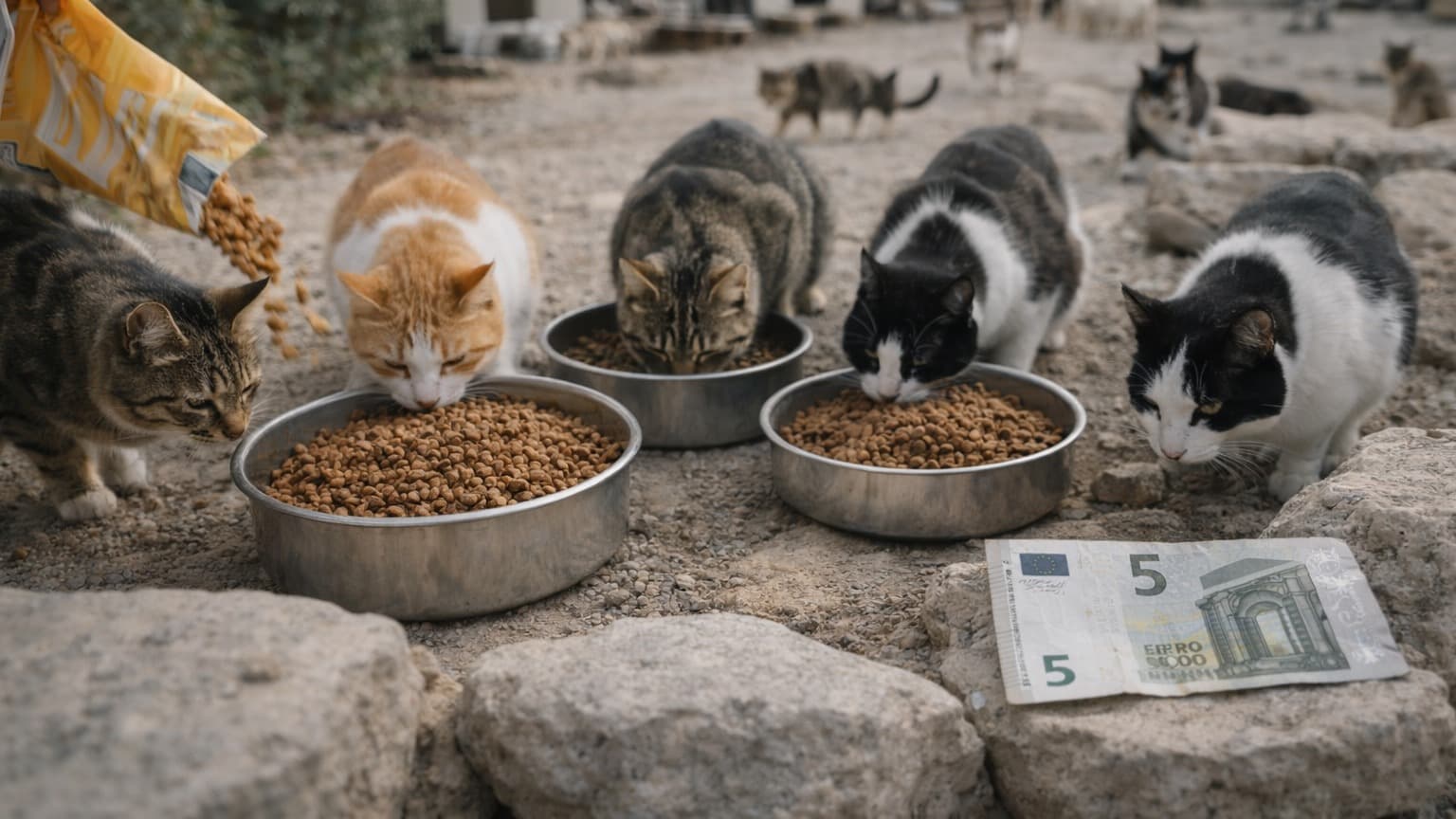
Bulk dry cat food in Cyprus, purchased from agricultural suppliers rather than pet shops, costs approximately €0.35 to €0.50 per kilogram. A kilogram of decent-quality dry food contains roughly 3,500–4,000 calories. That means one kilogram feeds one cat for approximately 12 to 14 days, or feeds 12 to 14 cats for one day.
At €0.35 per kilogram, feeding 14 cats for one day costs €0.35. Feeding them for two weeks costs roughly €5.
This is the number that surprises people. Five euros. Two weeks. Fourteen cats.
Of course, this is the minimum. Kittens, nursing mothers, and sick cats require more food and often more expensive food — wet food, kitten formula, or veterinary diets. But for the baseline maintenance of a stable, sterilised colony of adult cats, the per-head feeding cost is remarkably low.
Scaling Up: Monthly and Annual Costs
A volunteer managing a colony of 30 cats can expect to spend approximately €25–€40 per month on dry food alone. Add in occasional wet food for sick cats, flea treatment (approximately €2–€4 per cat per month for spot-on treatments purchased in bulk), and basic first aid supplies (wound spray, eye drops), and the monthly cost for a 30-cat colony runs to approximately €60–€100. This burden is why volunteer support is critical.
That is €720–€1,200 per year to maintain a colony of 30 cats at a basic level of care. It is not nothing, but it is far less than most people assume, and it is frequently paid entirely out of one volunteer's pocket.
The larger sanctuaries and rescue operations in Cyprus, managing 50 to 200+ cats, face proportionally higher costs. A sanctuary feeding 100 cats spends approximately €200–€350 per month on food alone. Add veterinary care, and the numbers increase substantially — but the food cost per head remains the same.
The Sterilisation Economics
Feeding is the ongoing cost. Sterilisation is the investment that makes all other costs manageable.
A spay surgery for a female cat in Cyprus costs approximately €40–€80 at a private veterinarian, depending on the clinic and location. Neuter surgery for a male cat costs approximately €30–€50. Some subsidised programmes, when they exist, bring costs down to €15–€25 per surgery.
These numbers are significantly lower than in Western Europe or North America, where equivalent surgeries can cost €150–€400. Cyprus's lower veterinary costs are one of the few structural advantages in the stray cat situation.
The return on investment for sterilisation is straightforward. One unspayed female, left to breed, can produce 12 to 18 kittens per year. Each of those kittens will require food, may require veterinary care, and — if female — will begin breeding at five to six months of age. Within two years, a single unspayed female can be responsible for 50 or more descendants.
Sterilising that one female costs €40–€80 and permanently eliminates her contribution to population growth. The food cost savings alone — not feeding 12–18 additional cats per year — pay for the surgery within months. The veterinary cost savings from reduced disease transmission (fewer fights, fewer FIV infections, fewer kitten emergencies) compound over years.
This is why every experienced rescue operator in Cyprus will tell you the same thing: if you have €50 to spend, spend it on sterilisation, not food. Food keeps cats alive today. Sterilisation prevents the crisis from growing tomorrow.
The Volunteer Labour Gap
The largest cost in stray cat care is one that rarely appears on any budget: volunteer labour. The hours spent trapping, transporting to and from veterinary clinics, cleaning feeding stations, socialising kittens for adoption, managing social media fundraising, coordinating foster homes, and driving across the island to respond to reports of sick or injured cats represent an enormous economic contribution that is completely unpaid.
A single dedicated volunteer in Cyprus may spend 20–40 hours per week on cat rescue activities. At even a conservative estimate of €10 per hour (well below any professional rate for comparable work), that represents €800–€1,600 per month in labour value — per volunteer.
Across the island, hundreds of volunteers contribute thousands of hours per week. The aggregate labour value easily runs into millions of euros annually. This is the hidden subsidy that allows the entire informal rescue system to function. If volunteers were paid even minimum wage for their work, the cost of stray cat management in Cyprus would multiply tenfold, and the current system would collapse overnight.
This is important context for anyone evaluating the efficiency of rescue organisations. When a small charity reports annual expenditures of €10,000–€20,000, it is not because they are doing €10,000 worth of work. It is because they are doing €100,000 worth of work and absorbing €80,000–€90,000 of it as unpaid personal labour.
Why Small Donations Scale
The economics of stray cat care in Cyprus create an unusual situation where small donations have disproportionate impact. There are several reasons for this.
Low unit costs. When a spay surgery costs €40 and a month of food for a cat costs €3–€4, a donation of €20 is not a token gesture. It is a meaningful operational contribution. A €50 donation sterilises a cat. A €100 donation sterilises two cats and feeds a colony for a month.
Leverage through volunteer labour. Every euro donated is multiplied by the unpaid labour of volunteers who will trap, transport, and care for the animal. The donor provides the €40 for surgery. The volunteer provides the five hours of work to trap the cat, drive to the clinic, wait, drive back, and monitor recovery. The total value of the intervention far exceeds the cash donation.
Compounding returns. Sterilisation creates permanent, compounding savings. Every cat sterilised today is a cat that will not produce 12–18 kittens next year, each of whom would have required food, medical care, and eventual sterilisation themselves. The return on a €40 sterilisation compounds over the animal's remaining lifespan.
Direct impact. In a system without layers of bureaucracy, administrative overhead, or institutional inertia, donations reach the animals quickly. A volunteer who receives a €50 donation on Monday can have a cat sterilised by Wednesday. There is no grant application, no committee review, no quarterly reporting cycle. The money moves at the speed of the volunteer's WhatsApp group.
The Gap Between What Is Spent and What Is Needed
Current spending on stray cat management in Cyprus — combining municipal budgets, charity expenditures, and volunteer out-of-pocket costs — falls far short of what would be required to bring the population under control.
Estimates vary, but sterilising enough cats to stabilise the population would require sterilising approximately 70–75% of breeding females. At an estimated population of 1.5 million, with roughly 40% being breeding-age females, that means sterilising approximately 420,000–450,000 cats. At an average cost of €50 per surgery, that is a one-time investment of €21–€22.5 million.
That number sounds large in isolation. It is less than a single kilometre of motorway. It is roughly what Cyprus spends on tourism marketing in a year. It is a policy choice, not an economic impossibility. This is why comprehensive solutions like a mandatory registry are essential to drive scale.
Until that investment is made, the system will continue to rely on the unpaid labour and personal funds of volunteers who are, in the most literal sense, subsidising a government responsibility with their own time and money.
The economics are clear. The question is not whether the problem can be solved. It is whether anyone with a budget is willing to solve it.
Related posts
 CYPRUS CAT CRISIS
Why Cyprus Has 1.5 Million Stray Cats — And Why the Problem Keeps Getting Worse
Colonial-era feeding traditions, failed sterilisation campaigns, infectious disease, and municipal indifference have created Europe's worst stray c…
7 min read
Read → CYPRUS CAT CRISIS
What Happens to Stray Cats in Cyprus When No One Intervenes
Without active management, stray cat colonies do not simply persist. They collapse — through disease, starvation, and ecological damage that extend…
7 min read
Read → ADOPTION
International Pet Adoption from Cyprus: Costs, Timelines, and What Nobody Tells You
EU pet passports, airline cargo fees, rabies titre tests, quarantine rules, and the real cost range of adopting a rescue animal from Cyprus. A prac…
7 min read
Read →