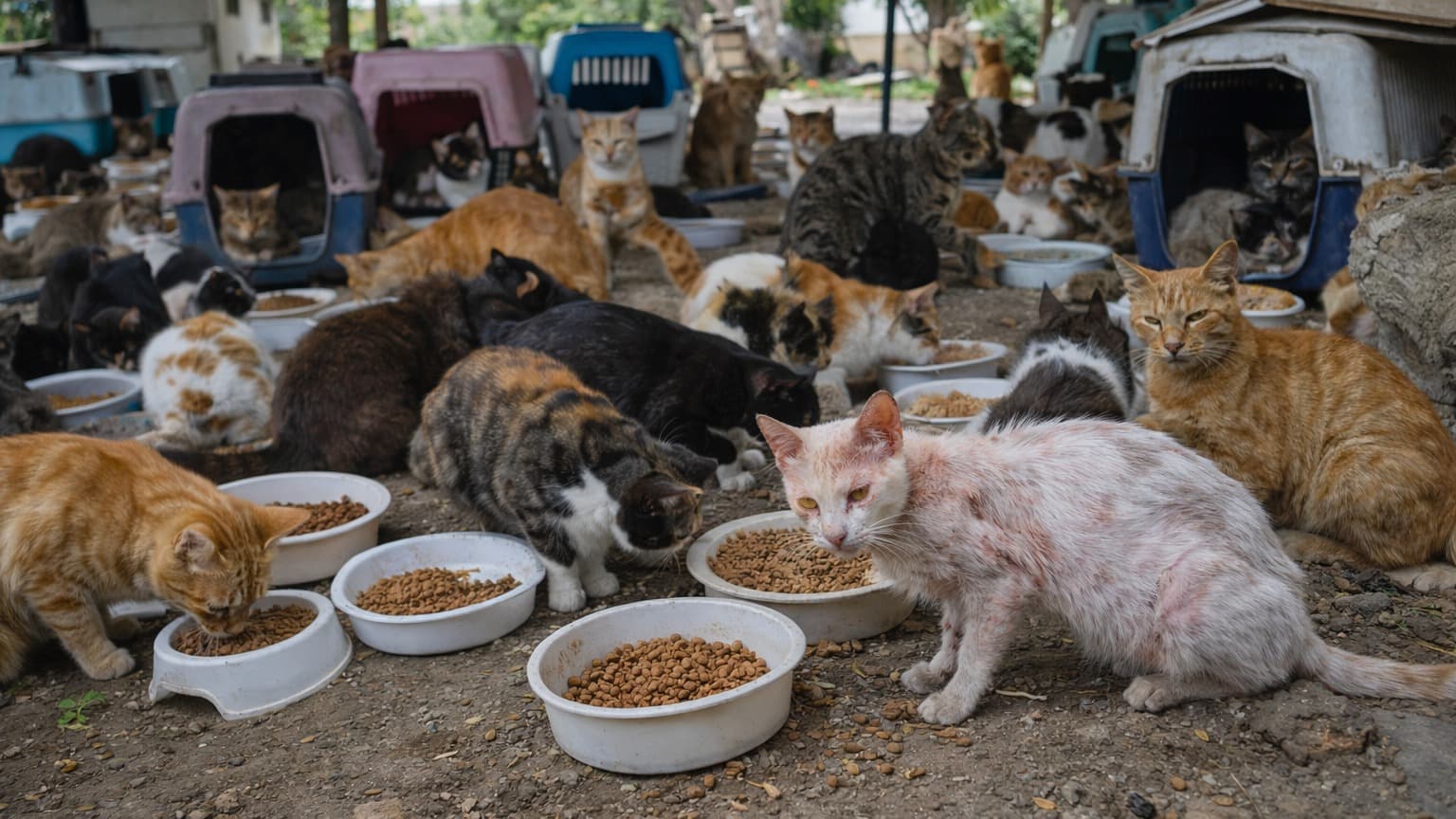
Nobody running a cat sanctuary says this out loud: it bleeds money. Constantly, quietly, and then suddenly all at once when three cats need surgery in the same week you have already overrun the vet budget.
This is not a complaint. It is a structural observation — and it matters, because the people who care most about this problem are the ones absorbing the most cost, and that arrangement is not sustainable no matter how much they care.
The numbers nobody publishes
The real economics of stray cat care in Cyprus are not complicated. Food, veterinary care, trap-neuter-return operations, medications, bedding, enclosures, repairs. Then the administrative overhead that comes with caring for animals who cannot tell you where it hurts until they are already very sick. Then the emergencies, which are not exceptional events — they are a regular feature of running a sanctuary at any meaningful scale.
A colony of 20 cats is manageable with discipline and a small network of supporters. A sanctuary of 90 cats is a different kind of operation. The costs do not scale linearly. Veterinary emergencies cluster. Infectious disease moves through a population. A single cat with a chronic condition can cost more in a year than feeding the entire colony.
The government of Cyprus allocates almost nothing to this problem. Municipal budgets for stray animal management are scattered and insufficient. The EU has declined to treat it as a matter requiring external support. The people left holding the cost are the volunteers, the sanctuary operators, and the small networks of donors who give what they can when they remember to.
Why the current model keeps failing
The donation model is not a bad model because donors are bad people. It is a bad model because it is structurally mismatched to the problem it is trying to solve. What the real economics actually demand is far more than episodic generosity.
Donations are episodic. Animal welfare costs are continuous. Donations spike after a viral post, a media story, a particularly affecting photograph. Then they drop. The cats do not drop. The food bill does not drop. The vet appointments do not reschedule themselves around the fundraising calendar.
Donations are episodic. Animal welfare costs are continuous. The cats do not adjust to the fundraising calendar.
Volunteer burnout compounds this. The people running sanctuaries in Cyprus are not doing it because it is easy or well-compensated. They are doing it because they cannot look away. That is not a renewable resource. When they burn out — and many do — the animals they were caring for do not automatically find a new home. They return to the street, or the colony collapses, or another already-stretched operator takes on more than they can carry.
This is the cycle. It has been the cycle for decades. Cyprus has 1.5 million stray cats and the number is not falling. The effort being expended is real and it is not enough, not because the people are failing, but because the model they are working within cannot succeed.
What sustainable actually means
Sustainable does not mean comfortable. It does not mean profitable. It means the operation can continue next year, and the year after, without depending on a specific person's capacity for sacrifice or a specific donor's continued generosity.
That bar — continuity without dependency on individual heroism — is higher than it sounds. Almost no sanctuary operating in Cyprus today clears it. Almost all of them are one bad year away from a crisis.
The real economics piece shows what a small, well-run feeding operation costs at the colony level. Scale that to a full sanctuary and the numbers become significant quickly. Significant enough that the question of where the money comes from is not a secondary concern. It is the primary one.
Which is why the more useful question is not how to raise more donations. It is whether there is a model where the money does not need to be raised at all — because it is being generated by something the sanctuary already owns.
Next in this series: What if the land paid for itself? A look at the property types in Cyprus that are structurally suited to hosting a sanctuary — and generating the income to run one.
Tinies is a pet services marketplace built to fund animal sanctuaries across Cyprus. If you want to understand how the booking commission model works, read more here.