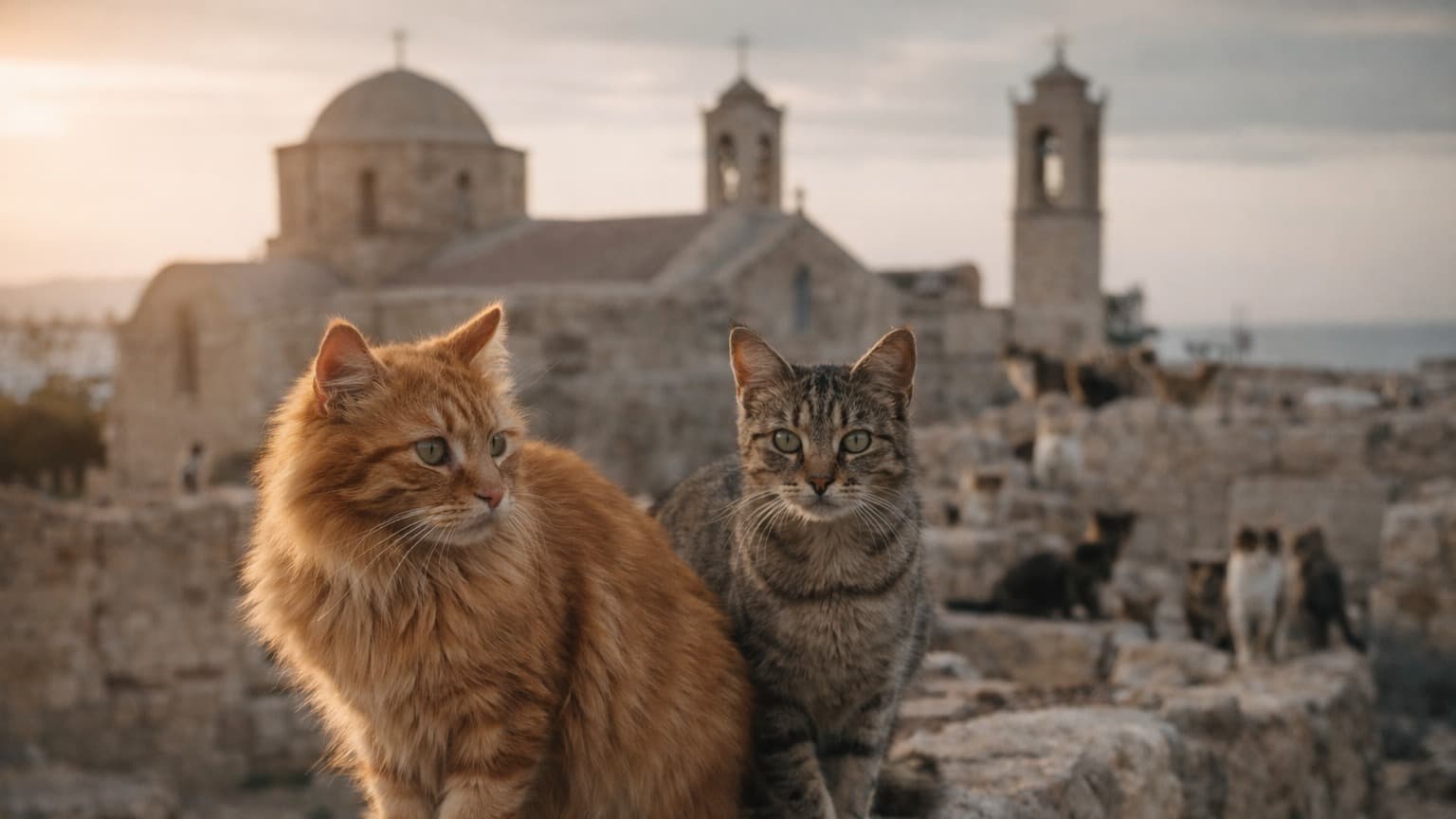
If you spend any time in conservation circles discussing Cyprus, you will eventually encounter the argument: cats are an invasive species, and they are destroying the island's wildlife.
It is not entirely wrong. But it is not entirely right, either. And the conclusion that most people jump to — that the cats need to be removed — is both impractical and counterproductive. The reality is more complicated, more interesting, and more solvable than the debate usually allows.
The ecological pressure is real
Domestic and feral cats are predators. They hunt birds, lizards, rodents, and insects. In an island environment like Cyprus, where many species evolved without mammalian predators, this hunting pressure can be significant.
Cyprus is home to several endemic and near-endemic bird species that face predation pressure from cats. The Cyprus warbler (Sylvia melanothorax) and the Cyprus wheatear (Oenanthe cypriaca) are both species of conservation interest. BirdLife Cyprus has documented concerns about cat predation on ground-nesting birds, particularly in areas where feral cat colonies are concentrated.
Lizard species, including the Troodos lizard (Phoenicolacerta troodica), also face predation. Cats are efficient hunters — even well-fed domestic cats hunt instinctively — and in areas with high feral cat density, the cumulative impact on small vertebrate populations is real.
This is not unique to Cyprus. Studies from Australia, New Zealand, Hawaii, and other island systems have documented the impact of feral cats on native wildlife. Cats are listed among the world's worst invasive species by the International Union for Conservation of Nature (IUCN).
So yes, the ecological concern is legitimate.
The cultural reality is also real
Cats have been part of human life on Cyprus for at least 9,500 years — longer than anywhere else on Earth. Archaeological evidence from Shillourokambos near Parekklisia shows that Neolithic settlers deliberately brought cats to the island by boat around 7,500 BC. A cat was buried alongside a human companion in what is the oldest known evidence of the human-cat bond.
In the fourth century AD, Saint Helen reportedly sent boatloads of cats to the monastery of Saint Nicholas of the Cats to control venomous snakes. Cats have been integrated into Cypriot life, culture, and even religious tradition for millennia.
Today, the Cyprus cat (Aphrodite's Giant) is recognised as a distinct breed by the World Cat Federation. These cats are not just any strays — they are a genetically distinct landrace adapted to the island over centuries.
When someone proposes that cats should be removed from Cyprus, they are proposing the removal of an animal that has been part of the island's cultural and ecological fabric for nearly ten thousand years. That is not a practical proposal. It is not even a coherent one.
Why culling does not work
The instinctive response to an overpopulation problem is removal. Trap and kill. Poison. Shoot. This has been tried in various places around the world, and the evidence is clear: for free-roaming cat populations in urban and semi-urban environments, culling does not work.
The reason is the vacuum effect. When cats are removed from an area, the territory opens up. Cats from surrounding areas move in to fill the vacuum, attracted by the same food sources and shelter that supported the original population. Within months, the population returns to its previous level — sometimes higher, because the newcomers are unsterilised.
This is not theoretical. Studies on lethal control of feral cats in urban environments have consistently shown that populations rebound unless the underlying carrying capacity of the environment is addressed. You can kill every cat in a neighbourhood, and if the restaurant still leaves food waste in open bins, new cats will appear.
Australia's experience is instructive. Despite one of the most aggressive feral cat control programs in the world — including poisoning, trapping, and shooting — Australia has not significantly reduced its overall feral cat population. The approach works in isolated, fenced reserves (where new cats cannot migrate in), but not in open, connected urban or semi-urban landscapes like Cyprus.
What actually works: TNR at scale
Trap-Neuter-Return (TNR) is the evidence-based approach to managing free-roaming cat populations. The principle is simple: trap feral cats, sterilise them, and return them to their territory. Sterilised cats continue to occupy territory (preventing the vacuum effect) but do not reproduce. Learn more from Alley Cat Allies' comprehensive TNR resources.
Over time, the population declines through natural attrition. Studies of TNR programs in cities including Rome, Chicago, and across the United States have shown population reductions of thirty to seventy percent over five to ten years when TNR is implemented at sufficient scale.
The key phrase is "at sufficient scale." TNR works when it reaches a critical mass of the population — typically seventy to eighty percent of cats in a colony need to be sterilised for the population to decline rather than stabilise. Below that threshold, the remaining unsterilised cats produce enough kittens to maintain the population.
In Cyprus, TNR programs exist but have not reached the scale needed to bend the population curve. Rescue organisations sterilise thousands of cats each year, but the total feral population is estimated at 1.5 million. Reaching seventy percent sterilisation coverage at that scale requires systematic, funded, island-wide effort — not ad hoc volunteer work.
## The funding gap
Here is where the problem becomes circular. Effective TNR at scale requires money — for traps, veterinary services, transport, and the ongoing management of feeding stations. The Cyprus government allocates limited funds to stray management. The EU has declined to provide support, classifying it as a domestic issue. International animal welfare organisations provide some assistance but not at the level needed. See the real economics of stray cat care to understand the cost barriers.
The people actually doing the work are rescue volunteers, most of whom fund operations from personal savings and donations. Gardens of St Gertrude, a sanctuary in Parekklisia, has seen its founders invest over EUR 460,000 in rescue operations since 2017 — including paying vet bills for other rescue organisations across the island. They have sterilised over 160 cats.
But personal generosity cannot fund a national sterilisation program. The math does not add up.
A marketplace-shaped solution
What if every dog walk booked in Limassol generated a small amount of funding for TNR? What if every pet sitting booking in Nicosia, every overnight boarding stay in Larnaca, every drop-in visit in Paphos contributed to a fund that pays for sterilisation surgeries?
That is what Tinies does. Ninety percent of every commission from the pet services marketplace goes directly to rescue organisations. As booking volume grows, the funding grows with it — predictably, monthly, without depending on any single donor or government decision.
At scale, this model could generate thousands of euros per month flowing directly to the organisations doing TNR work on the ground. It is not enough to solve the crisis alone. But it is a funding mechanism that compounds — every new user, every new provider, every new booking adds to the stream.
The ecological problem of cats in Cyprus is real. The cultural heritage of cats in Cyprus is also real. The solution is not to pick a side. The solution is sterilisation at scale, funded sustainably, and integrated into the daily economic activity of the island.
Every booking helps. Find a pet care provider on Tinies or support rescue directly through Tinies Giving.
Related posts
 RESCUE STORIES
The Island Where Cats Were First Loved: A 9,500-Year History
The oldest evidence of the human-cat bond was found in Parekklisia, Cyprus — exactly where a cat sanctuary stands today. From Neolithic burials to …
7 min read
Read → RESCUE STORIES
We Asked the EU for Help with Cyprus' Cat Crisis. They Said No.
Cyprus has more stray cats than people. When the government sought EU support, Brussels said it was a domestic problem. So the people of Cyprus are…
8 min read
Read → RESCUE STORIES
The Government of Cyprus Spends Almost Nothing on Stray Animals. Here's What Actually Happens.
Municipal budgets for stray management are thin. National policy is scattered. The real work — and the real cost — falls on volunteer rescue organi…
6 min read
Read →