Most people assume cats were first domesticated in ancient Egypt. The golden hieroglyphs, the cat goddess Bastet, the mummified felines found in temple tombs — Egypt has always felt like the natural origin story for our relationship with cats.
It isn't.
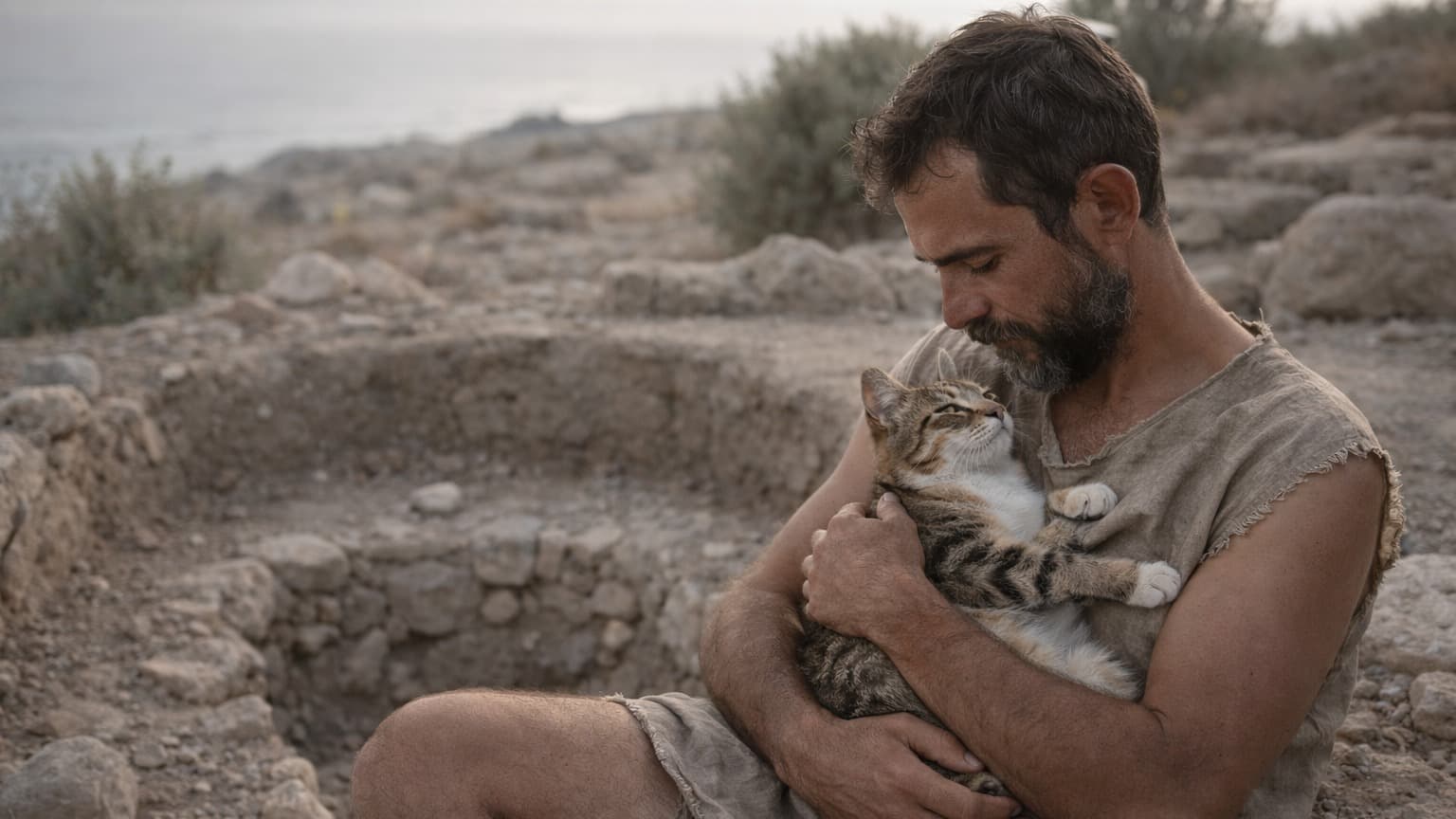
The oldest evidence of a deliberate emotional bond between a human and a cat was discovered on a low plateau near the village of Parekklisia, six kilometres east of Limassol, Cyprus. The site is called Shillourokambos, a Pre-Pottery Neolithic settlement that was occupied from roughly 8,200 to 7,000 BC — thousands of years before the earliest Egyptian cat depictions.
A burial that changed everything
In 2004, a team of French archaeologists led by Jean-Denis Vigne of the National Museum of Natural History in Paris published a remarkable finding in the journal Science. At Shillourokambos, they had uncovered the skeleton of an eight-month-old cat buried just forty centimetres from a human grave. The human, estimated to be about thirty years old, was interred with seashells, polished stone axes, ochre, and flint tools — offerings that suggest someone of social importance.
The cat had been placed deliberately. Its bones were articulated, meaning the animal was buried whole, not scattered as food waste. The orientation of cat and human was parallel. This was not an accident. This was a companion burial — someone had placed their cat beside them for the afterlife.
The grave is approximately 9,500 years old. It predates the earliest Egyptian evidence of domesticated cats by more than four thousand years.
Melinda Zeder, a curator of Old World archaeology at the Smithsonian Institution, was quoted at the time as saying: in the absence of finding a bell around its neck, this was about as solid evidence as one could have that cats held a special place in the lives of these ancient people.
Why Cyprus matters
Cats are not native to Cyprus. The island has been separated from mainland Turkey and the Levant since its geological formation. No wild feline species existed on Cyprus before humans arrived. Every cat bone ever found in a Cypriot archaeological site was brought there by people — deliberately, on boats.
The Neolithic settlers who colonised Cyprus around 10,000 years ago came from what is now southeastern Turkey. They brought with them sheep, goats, cattle, pigs, dogs, foxes, and deer — a kind of Noah's Ark of early domestication experiments. Among these animals were cats.
The fact that cats were transported to an island by boat is significant. You do not put a wild animal on a boat unless you want it there. These were not stowaways. They were companions, or at least valued pest controllers who had already begun to live alongside humans.
Earlier finds at the site of Khirokitia, also in Cyprus, had revealed cat jawbones in Neolithic sediment dating to around 6,000 BC. But the Shillourokambos burial pushed the timeline back by a thousand years and provided the first unambiguous evidence of an emotional human-cat relationship.
The monastery of cats
Fast forward several thousand years. In the fourth century AD, according to Byzantine tradition, Helena of Constantinople — Saint Helen — shipped hundreds of cats from Egypt or Palestine to a monastery on the Akrotiri peninsula in Cyprus. The island was suffering from a drought lasting thirty-seven years, and venomous snakes had overrun the area.
The monastery, known as Saint Nicholas of the Cats (Ágios Nikólaos ton Gatón), kept two bells: one to call the cats to meals, and another to send them into the fields to hunt snakes. The cats served a practical purpose, but they were also cared for and fed by the monks. The monks understood something that modern animal welfare would later confirm: care and practical purpose can coexist.
The monastery still exists today as a nunnery, and cats still live there. The population dwindled at one point but has been revived by the resident nuns.
This is not an isolated legend. It reflects a pattern that has repeated across Cyprus for millennia: cats arriving on the island, integrating with human communities, and being valued — sometimes practically, sometimes emotionally, sometimes spiritually.
The Cyprus cat breed
Modern cats on Cyprus have been breeding with relatively little outside influence for centuries. This has produced a distinct, locally adapted variety that cat fancier organisations have begun to recognise as a breed.
The World Cat Federation (WCF) fully recognises the breed under the name Aphrodite's Giant. The International Cat Association (TICA) has granted provisional recognition under the name Aphrodite. These are large, muscular cats — significantly bigger than the average European domestic cat — with a genetic profile distinct enough from mainland Turkish cats to warrant breed status.
Genetic testing in the early 2010s by Leslie A. Lyons at the University of California, Davis confirmed that Cyprus cats belong to a lineage as genetically distinct as the Turkish Van, with limited mainland admixture in recent times.
Whether these modern cats are direct descendants of the Neolithic wildcats brought to Cyprus 10,000 years ago is uncertain — the Wikipedia article on Cyprus cats notes that there is no confirmed genetic link between ancient and modern Cypriot felines. But the cultural continuity is undeniable. Cats have been part of the fabric of life on this island for nearly as long as humans have.
From first love to crisis
Today, Cyprus has an estimated 1.5 million stray and feral cats for a human population of roughly 1.2 million. More cats than people. The reasons are complex — a warm climate that supports year-round breeding, insufficient spay and neuter programs, limited government funding for animal welfare, and a cultural norm of outdoor cats that makes population control difficult.
In 2023, the island experienced a devastating outbreak of feline infectious peritonitis (FIP) caused by a highly pathogenic coronavirus that killed thousands of cats across the country. The crisis exposed the fragility of a system that depends almost entirely on volunteer-run rescue organisations operating on personal donations.
The rescue organisations of Cyprus — and there are dozens of them — do extraordinary work. They trap, neuter, return. They foster kittens. They coordinate international adoptions to the UK, Germany, the Netherlands, and Scandinavia. They pay veterinary bills they cannot afford. Many of the people running these organisations have been doing this work for years, funded by their own savings and the generosity of strangers on Facebook.
Parekklisia today
Gardens of St Gertrude is a cat sanctuary in Parekklisia — the same village where Shillourokambos sits. The same land where a human buried their cat companion 9,500 years ago is now home to ninety-two rescue cats.
Since 2017, the founders have personally invested over EUR 460,000 in animal rescue across Cyprus — not just their own cats, but paying veterinary bills for other rescue organisations who could not cover emergency care. They have spayed and neutered over 160 cats.
That personal funding is not sustainable forever. That is why Tinies exists.
Tinies is a pet services marketplace where every booking — dog walking, pet sitting, overnight boarding — generates funding for rescue animals. Ninety percent of every commission goes directly to sanctuaries and rescue organisations across Cyprus. The platform also coordinates international adoption, connecting rescue animals in Cyprus with homes across Europe.
The idea is simple: the same island that first loved cats 9,500 years ago should be able to care for them now.
What you can do
If you are in Cyprus, you can book a pet care provider through tinies.app. Every booking funds rescue.
If you are in the UK or Europe, you can adopt a rescue cat from Cyprus. Tinies coordinates the entire process — veterinary preparation, EU pet passport, transport, and post-adoption follow-up.
If you want to support rescue directly, you can become a Tinies Guardian — a monthly donor starting from EUR 3/month — or make a one-time donation through the Tinies Giving page.
Nine thousand five hundred years ago, someone on this island loved a cat enough to be buried beside it. The bond has not changed. The need has never been greater.
Related posts
 RESCUE STORIES
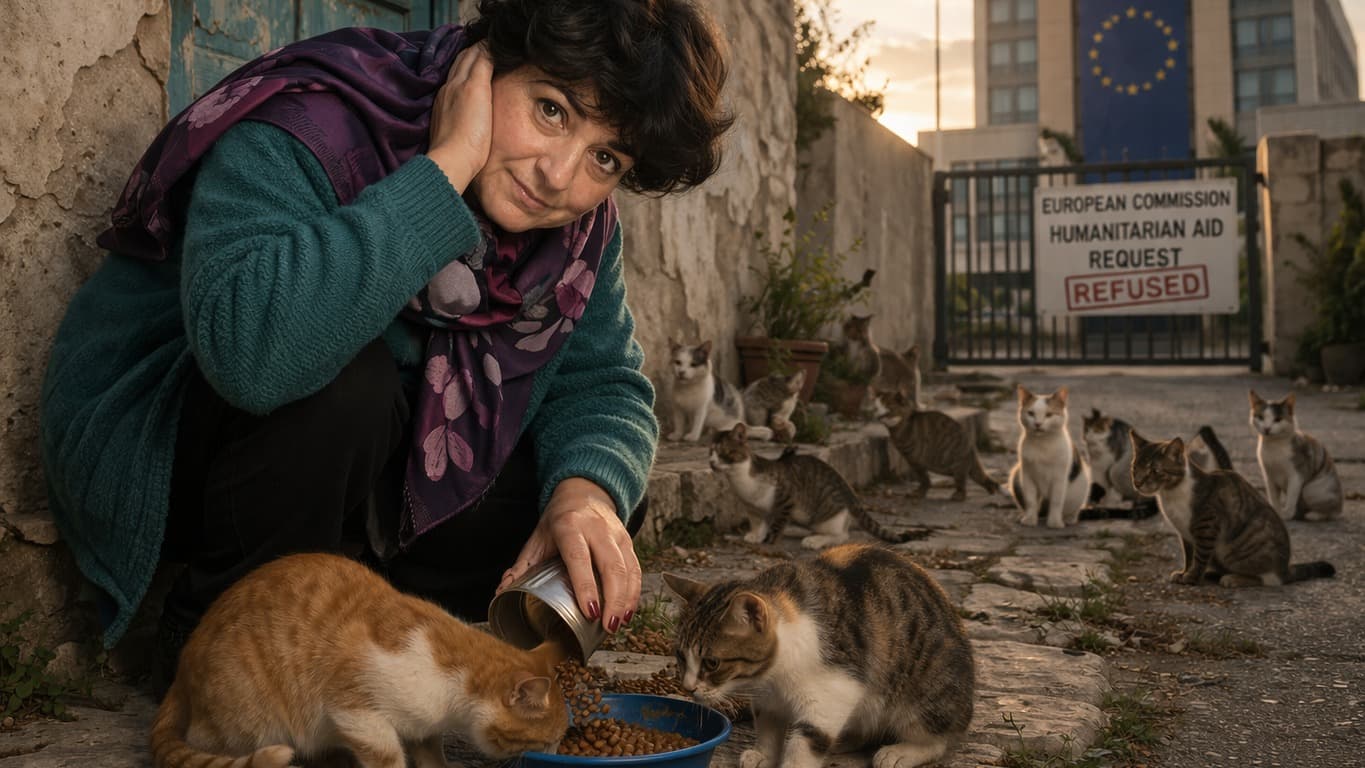
We Asked the EU for Help with Cyprus' Cat Crisis. They Said No.
Cyprus has more stray cats than people. When the government sought EU support, Brussels said it was a domestic problem. So the people of Cyprus are…
8 min read
Read →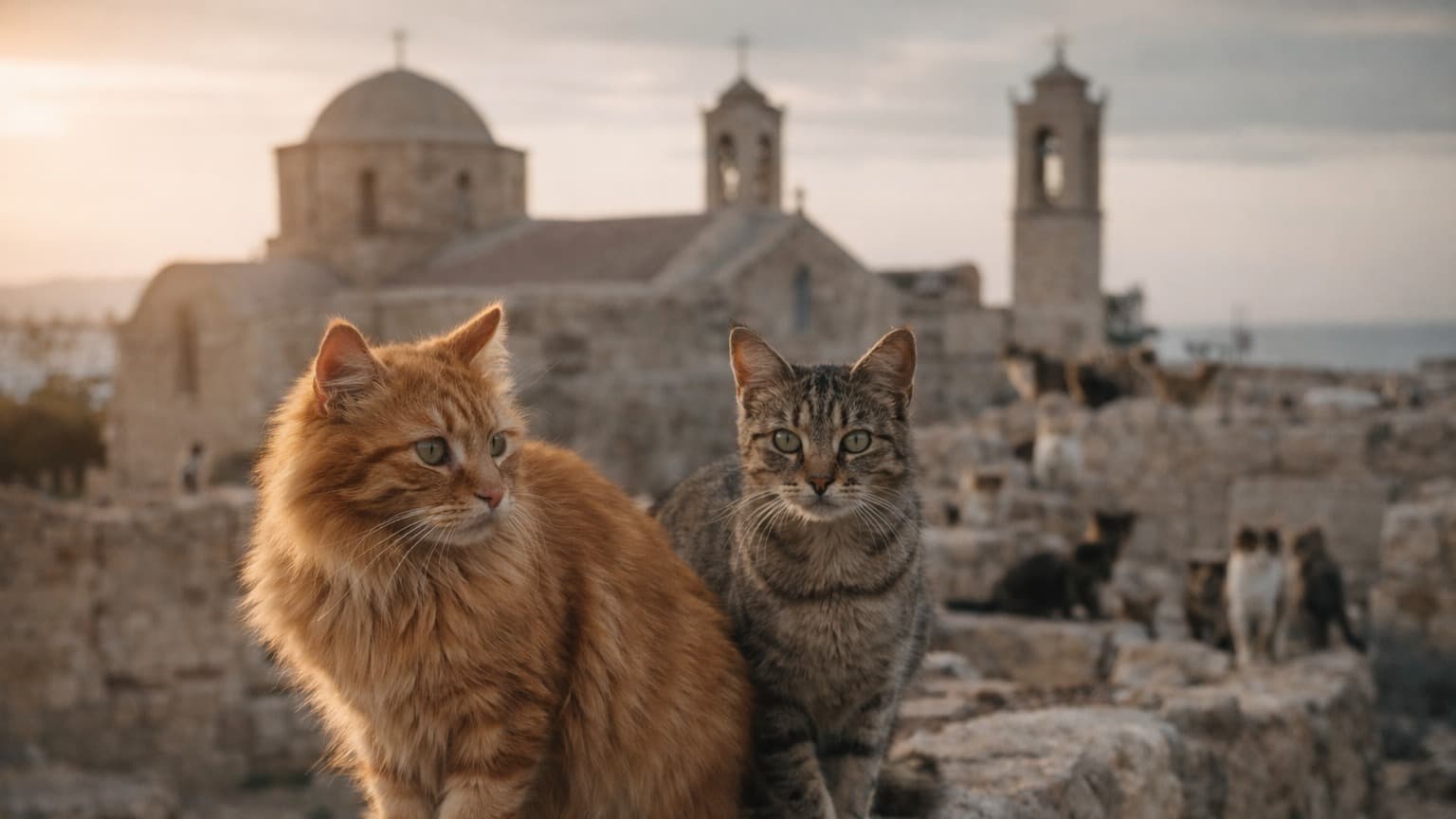 RESCUE STORIES
The Real Ecology of Cats in Cyprus: Invasive Species or Cultural Heritage?
Cyprus cats are simultaneously the island's oldest cultural companions and a pressure on its endemic wildlife. The solution is not extermination. I…
7 min read
Read → RESCUE STORIES
The Government of Cyprus Spends Almost Nothing on Stray Animals. Here's What Actually Happens.
Municipal budgets for stray management are thin. National policy is scattered. The real work — and the real cost — falls on volunteer rescue organi…
6 min read
Read →