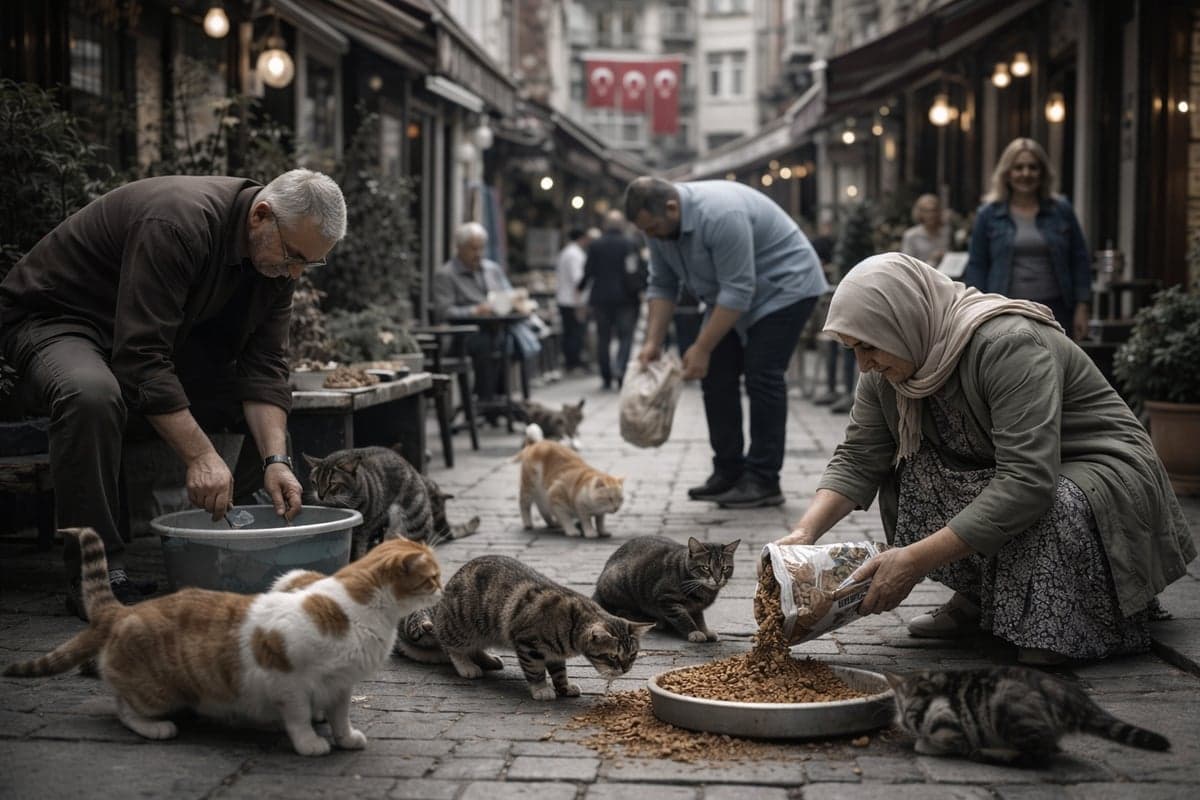
Istanbul is often described as the world's cat capital, and the description is not entirely marketing. The city has an estimated 125,000 to 250,000 free-roaming cats, a blanket no-kill, no-capture policy, and a cultural relationship with street animals that has no equivalent in Europe.
Turkish citizens do not view street cats as strays in the Western sense. They are sokak kedisi — street cats — treated as communally owned rather than homeless. Residents leave food and water outside shops. Municipalities build shelters and feeding stations integrated into public infrastructure. The 2016 documentary Kedi brought this relationship to global attention, and the city's cats have become one of its most recognizable cultural exports.
The question for Cyprus — which shares many of Istanbul's structural conditions (Mediterranean climate, dense urban cat populations, cultural tolerance of street animals, tourism-dependent economy) — is whether the Istanbul model can be adapted, and where it breaks down.
What Istanbul Gets Right
Three elements of Istanbul's approach are genuinely effective and replicable.
The first is institutional veterinary infrastructure. The Istanbul Metropolitan Municipality operates veterinary clinics and mobile "Vetbus" units that move between neighborhoods, providing vaccination, sterilization, microchipping, and treatment for street animals at no cost to residents. In 2018, the municipality cared for over 73,000 animals — up from just 2,470 in 2004. One hundred veterinarians and veterinary technicians are employed by the municipality specifically for this purpose.
Cyprus has nothing comparable. The entire national sterilization budget is €300,000, administered through a fragmented system of vouchers and individual veterinary clinics. There are no mobile veterinary units, no municipal veterinary staff dedicated to stray animals, and no centralized intake system.
The second element is the 2021 legal reform. Turkey reclassified animals from "commodities" to "living beings," enabling prison sentences of six months to four years for crimes against animals, including strays. This legal framework, while still imperfectly enforced, creates a deterrent against harm and a foundation for institutional investment.
Cyprus's animal protection laws exist but lack comparable teeth and scope, particularly regarding stray animals.
The third element is cultural integration at the municipal level. Istanbul's urban planning incorporates animal infrastructure — feeding stations, shelters, water points — as standard municipal amenities, treated with the same routine maintenance as park benches or streetlights. This normalizes the presence of managed animal populations and distributes the cost of care across public budgets rather than relying exclusively on volunteer labor.
Where Istanbul's Model Breaks Down
The Istanbul model has three significant limitations that Cyprus should understand before attempting to replicate it.
The first is that the no-kill policy, combined with inadequate sterilization coverage, means the population continues to grow. Despite sterilizing tens of thousands of animals annually, the municipality has acknowledged that "the animals that we do not catch continue to reproduce." The dog population has remained fairly stable, but the cat population has grown because — as one source notes — cats are not fixed at the same rate due to cultural and religious considerations in some communities.
The second limitation is disease prevalence. Feline immunodeficiency virus (FIV) and feline leukemia virus (FeLV) are common among Istanbul's outdoor cats. In areas without regular veterinary access, these diseases spread through colonies unchecked. A 2011 study found tapeworm infections in nearly 5 percent of examined cats, and rescuers report that FIP (feline infectious peritonitis) is widespread in underserved neighborhoods.
The third limitation is the gap between the romanticized image and the ground reality. While viral videos of cats riding ferries and sleeping in mosques dominate social media, Istanbul-based rescuers report significant suffering in peripheral neighborhoods where feeding networks are sparse and veterinary access is limited. As one rescuer who has worked in the city for nearly a decade noted, "the situation is not always as rosy as it seems when you dive deeper into the reality."
What Translates to Cyprus
Three elements of the Istanbul model are directly applicable to Cyprus's context.
Municipal veterinary mobile units. A single Vetbus-style mobile clinic operating across Limassol district — rotating between Parekklisia, Germasogeia, Agios Athanasios, and surrounding communities — could dramatically increase sterilization throughput without requiring new fixed infrastructure. The capital cost of a converted vehicle with basic surgical capability is modest relative to the sterilization budget.
Integrated urban animal infrastructure. Feeding stations, water points, and simple shelter structures installed and maintained by municipalities — rather than improvised by volunteers — would formalize the care network that already exists informally across Cypriot towns. The cost is minimal. The signal it sends to both residents and tourists is significant.
Animal reclassification. Strengthening Cyprus's legal framework to classify stray animals as protected living beings — with meaningful penalties for harm, abandonment, and interference with managed colonies — would create the legal foundation for everything else.
What Does Not Translate
Istanbul's model relies on a cultural relationship with street animals that evolved over centuries within an Ottoman and Islamic framework. Cyprus has its own cultural relationship with cats, but it is structurally different — less formalized, more ambivalent, and divided between genuine affection and a perception of cats as nuisance.
Simply declaring that Cyprus should "become like Istanbul" ignores these cultural differences. What Cyprus needs is not Istanbul's culture, but Istanbul's institutional infrastructure adapted to Cypriot conditions: municipal veterinary services, legal protection, and systematic data collection.
The culture will follow the institutions, not the other way around. When care for street animals is visibly supported by public investment, public attitudes shift. Italy's experience over thirty years confirms this, as does Istanbul's transformation from a city that once poisoned stray dogs to one that now employs a hundred veterinarians to care for them.
Read more in our international comparisons: Italy Gave Stray Cats Legal Rights in 1991, Malta Is Repeating Every Mistake Cyprus Made, and What Greece's Islands Teach Us About Cat Population Management.
For Cyprus-specific solutions, see our Solutions Series: The Single Injection, Cat Tourism as a €100M Industry, and Eradicate by District.
Tinies is a pet services marketplace where approximately 90 percent of booking commissions fund Gardens of St. Gertrude and other cat sanctuaries in Cyprus. Browse adoptable animals, find trusted pet care, or become a provider.
Related posts
 WHAT WORKS
The Mediterranean Stray Cat Scorecard: Who's Getting It Right and Who's Failing
We compared stray cat management across Cyprus, Malta, Greece, Italy, and Turkey on six dimensions. Only one country has a legal framework, institu…
6 min read
Read → WHAT WORKS
Italy Gave Stray Cats Legal Rights in 1991. Here's What Cyprus Can Learn From It.
Italy's Law 281 grants feral cats the right to live freely, mandates free neutering by public veterinary services, and legally recognizes colony ca…
6 min read
Read → WHAT WORKS
What Greece's Islands Teach Us About Cat Population Management
Greece has 3 million stray cats and dogs. But on certain islands and in refugee camps, targeted TNR programs have achieved over 90 percent steriliz…
6 min read
Read →