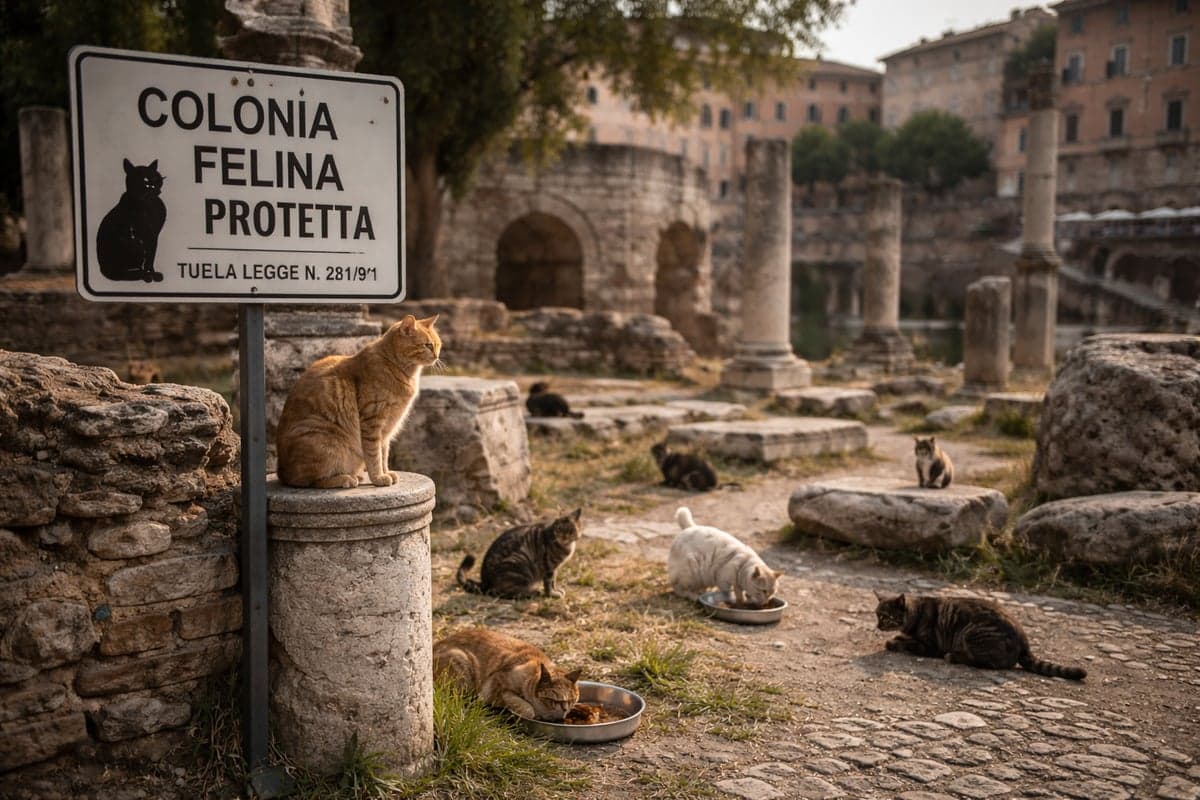
In 1991, the Italian Parliament passed Law 281, a piece of legislation that no other EU member state has replicated in its scope or ambition. The law established three principles that transformed how Italy manages its urban cat populations.
First, cats have the recognized right to live free. They cannot be killed, and they cannot be forcibly relocated from their chosen territory. Second, neutering of free-roaming cats by the Veterinary Services of the Local Health Unit is compulsory and provided at no cost. Third, colony caretakers — the gattare, or "cat ladies" — are institutionalized as recognized civic roles with legal standing.
The result, over three decades, is not a utopia. Rome still has an estimated 120,000 free-roaming cats living in registered colonies. But the system is stable, monitored, and measurably improving. A 30-year evaluation published in Frontiers in Veterinary Science found that TNR programs in Rome produced a 16 to 32 percent decrease in colony sizes, with the most significant declines occurring after sustained multi-year interventions.
Cyprus has none of these protections. There is no law recognizing feral cats' right to remain in their territory. There is no mandate for free public neutering. Colony caretakers have no legal standing and receive no institutional support. The entire burden of care falls on private volunteers and underfunded NGOs.
What Law 281 Actually Does
The law operates through a decentralized system. Municipal authorities are required to register cat colonies — defined as any group of two or more cats habitually occupying a defined area. Registration creates a legal entity tied to a geographic location. Once registered, the colony cannot be disturbed, displaced, or eliminated.
Each registered colony is assigned a caretaker, typically a volunteer who commits to daily feeding, health monitoring, and coordination with veterinary services for sterilization. The caretaker role is formalized through the local health unit, giving gattare legal access to colony sites and protection from interference.
Public veterinary services are required to sterilize free-roaming cats at no charge. Sterilized cats are ear-tipped for visual identification and returned to their colony. Veterinary records are maintained by colony, creating a longitudinal dataset that enables population tracking.
In 2001, the Rome City Council went further, declaring cats living in the Colosseum, the Roman Forum, and the Largo di Torre Argentina archaeological site part of the city's biocultural heritage. Harming these cats is punishable by law, and the colonies are maintained as a managed component of Rome's cultural landscape.
The Torre Argentina Cat Sanctuary, located in the ruins where Julius Caesar was assassinated, sterilizes between 5,000 and 6,000 cats per year and finds homes for over 100 cats annually. It operates primarily on volunteer labor and donations, but within a legal framework that guarantees its right to exist and function.
Why It Works — and Where It Falls Short
The Italian model works because it combines three elements that are absent in Cyprus: legal protection, institutional infrastructure, and data collection.
Legal protection prevents the cycle of removal and replacement that undermines ad hoc sterilization efforts. When colonies are protected in place, sterilized cats occupy territory and suppress immigration of unsterilized cats from adjacent areas. This is the mechanism that makes TNR effective at the colony level.
Institutional infrastructure — formalized caretakers, public veterinary services, colony registration — creates a system rather than a collection of individual efforts. Each colony is a managed unit within a larger network, and each caretaker is a node in a monitoring system.
Data collection enables evaluation. Because colonies are registered and sterilized cats are recorded, Rome can measure sterilization coverage, colony size trends, and the impact of immigration over time.
The model falls short in two areas that Cyprus should note. First, the 30-year study found that immigration from abandonment of owned cats continued to introduce unsterilized animals into managed colonies, partially offsetting TNR gains. This supports the case for a mandatory microchip registry to close the abandonment pipeline. Second, the model depends heavily on volunteer labor, which is not indefinitely sustainable without institutional funding.
What Cyprus Could Implement Tomorrow
Cyprus does not need to pass identical legislation overnight. But three components of the Italian model could be adopted through municipal regulation without national legislative action.
First, colony registration. Any municipality could create a registry of known cat colonies with GPS coordinates, estimated sizes, and sterilization status. This costs nothing beyond administrative time and immediately creates the data infrastructure that Cyprus currently lacks entirely. (See our piece on why Cyprus needs a population dashboard for more on this.)
Second, caretaker formalization. Recognizing existing volunteer feeders as registered colony caretakers — with legal access to feeding sites and a formal relationship with veterinary services — costs nothing and dramatically improves coordination.
Third, free or subsidized public sterilization linked to registered colonies. The existing €300,000 annual sterilization budget could be restructured to prioritize registered colonies, ensuring that resources are directed to mapped, monitored populations rather than distributed randomly.
None of these steps require EU approval, national legislation, or significant funding. They require organizational will.
The Cultural Dimension
Italy's success is partly cultural. Romans have lived alongside cats for millennia. The gattare tradition predates the law by centuries. Law 281 formalized a relationship that already existed informally.
Cyprus has a similar cultural foundation. The island's relationship with cats spans 9,500 years — the oldest documented cat-human burial on earth was found in Cyprus. Feeding strays is widespread. Volunteers already operate informally as colony caretakers across the island.
The cultural readiness exists. What is missing is the legal and institutional framework that converts compassion into a system.
Italy built that framework thirty years ago. Cyprus should study it carefully.
Read more in our Solutions Series: The Single Injection That Could End the Cyprus Cat Crisis, Eradicate by District, and The Cat Crisis Will Never Be Solved Without Fixing the Bins.
For background on the crisis itself, see The Stray Cat Crisis in Cyprus and Why Cyprus Has So Many Stray Cats.
Tinies is a pet services marketplace where approximately 90 percent of booking commissions fund Gardens of St. Gertrude and other cat sanctuaries in Cyprus. Browse adoptable animals, find trusted pet care, or learn how it works.
Related posts
 WHAT WORKS
The Mediterranean Stray Cat Scorecard: Who's Getting It Right and Who's Failing
We compared stray cat management across Cyprus, Malta, Greece, Italy, and Turkey on six dimensions. Only one country has a legal framework, institu…
6 min read
Read → WHAT WORKS
Istanbul Treats Its Street Cats as Community Pets. Could Cyprus Do the Same?
Istanbul has over 125,000 street cats, a no-kill policy, municipal veterinary clinics, and a culture that treats strays as shared pets. But the mod…
6 min read
Read → WHAT WORKS
What Greece's Islands Teach Us About Cat Population Management
Greece has 3 million stray cats and dogs. But on certain islands and in refugee camps, targeted TNR programs have achieved over 90 percent steriliz…
6 min read
Read →