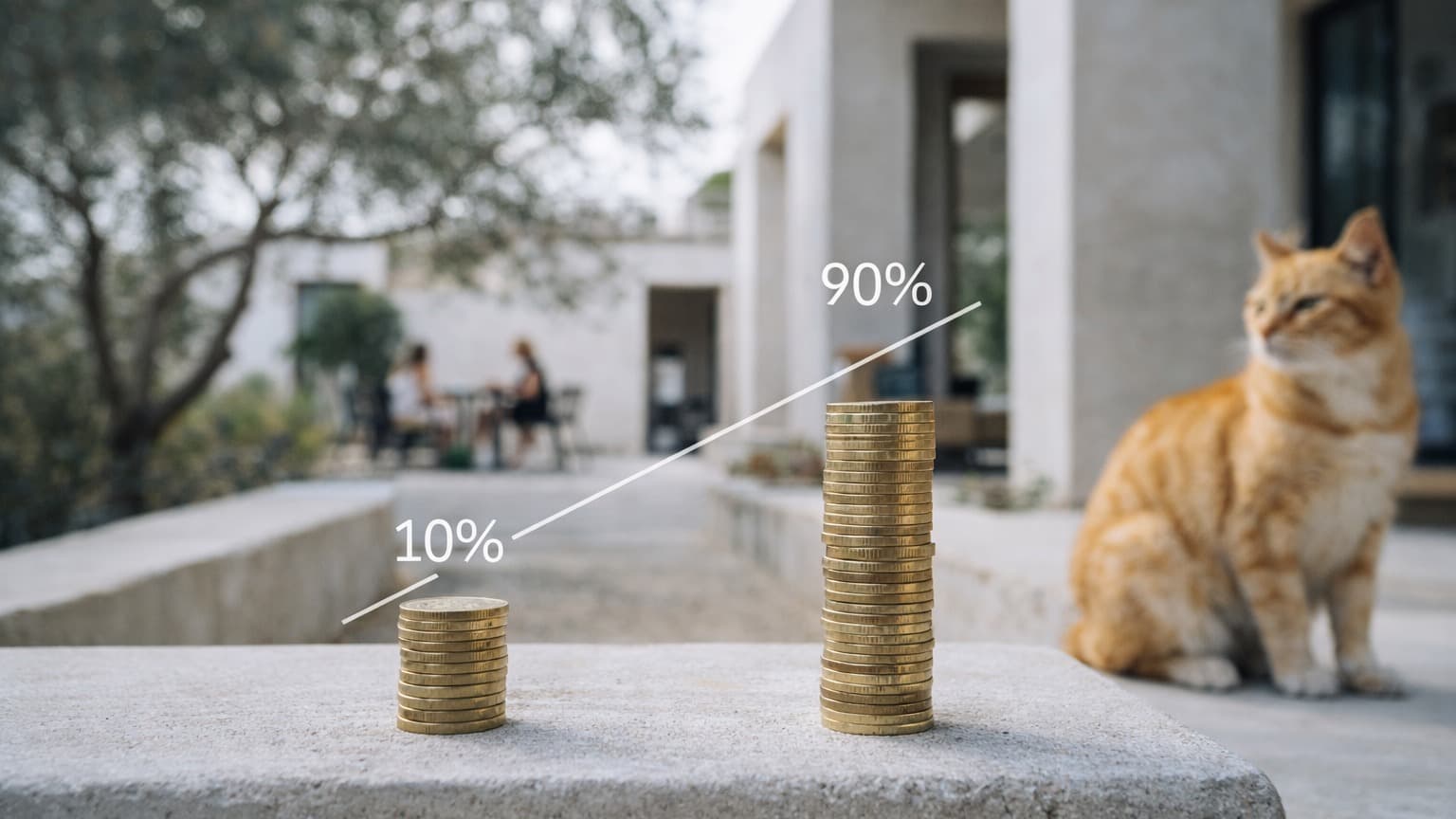
The question this series has been working toward is not really about cats. It is about structure. About whether the way we typically build things — raise money, generate revenue, donate a portion to a cause — is the only way, or whether there is a version where the cause and the commercial operation are the same thing from the start.
The 90% model is the answer we have arrived at. It is not the only answer. But it is a workable one, and it is worth explaining precisely — because the difference between a business that funds a mission and a business that is a mission is not semantic. It changes everything about how the business behaves.
What the model actually means
In the Tinies structure, 90% of every booking commission funds animal rescue operations in Cyprus. This is not a donation. It is not a pledge. It is a structural feature of how the revenue is allocated — written into the operating model, not decided month to month based on what is left over.
The distinction matters because of what it removes. When welfare funding is a donation, it competes with every other claim on revenue: operating costs, growth investment, team salaries, infrastructure. In a bad month, the donation gets cut. In a good month, it might get increased — but the animals cannot plan around that variability. They eat every day regardless of how the marketing campaign performed.
When welfare funding is structural, it is not competing with anything. It is a fixed output of the business, as reliable as the rent. The business is designed so that animal welfare improves as commercial performance improves. There is no version of growth that leaves the animals behind.
When welfare funding is structural, the animals are not competing with anything. They are a fixed output of commercial performance.
How to apply this beyond a marketplace
A marketplace is one format. The same logic applies to any business with a recurring revenue model and a physical or operational relationship to animals.
A vineyard that allocates a defined percentage of wine sales to the resident sanctuary. A guesthouse where a fixed nightly contribution to animal welfare is part of the room rate, disclosed to guests and non-negotiable. A craft producer — ceramics, olive oil, honey — where the margin structure is designed from the beginning to fund the colony that lives on the property.
In each case, the key design decision is the same: the allocation is structural, not discretionary. It is not a good-year bonus. It is a line in the operating agreement that exists regardless of whether the business is having a strong quarter.
This is harder to build than it sounds, for one reason: it requires saying, at the founding moment of the business, that a portion of revenue has a predetermined destination. That is a constraint. Most businesses resist constraints at the design stage because constraints feel like limitations on future flexibility.
What this constraint actually does is remove a recurring decision that would otherwise have to be made under pressure, in bad months, by people who are tired and worried about cash flow. The decision is made once, clearly, when everyone is thinking straight. Then it is never made again.
What this requires from the operator
Clarity about the number. Not "we try to give back as much as we can" — a specific percentage, applied to a specific revenue line, auditable by anyone who wants to check.
A legal structure that makes the commitment binding rather than aspirational. This does not need to be complicated. It can be a clause in the operating agreement, a constitutional document for a social enterprise, or a certification requirement if the property is part of a network like the Cause Hotel model described in the previous post in this series.
And transparency. The community that cares about this problem is sophisticated enough to tell the difference between a business that is genuinely structured around animal welfare and one that has placed a cat on its logo. Transparency is not just an ethical requirement. It is a commercial one. The trust it generates is the thing that makes the network effect work — the reason a guest chooses the certified property over the one that simply claims to be nice to animals.
Where this series lands
We started with the bleeding — the real cost of running a sanctuary on donations and willpower. We looked at the properties in Cyprus that are structurally suited to hosting animals and generating income at the same time. We walked through what a real acquisition looks like — how to finance it, what the constraints are, why Cyprus is specifically well-placed for this. We traced the origin of the Cause Hotel idea and why we still think it is right.
This final post is not a conclusion. It is an invitation.
If you are running a sanctuary and the math is not working: the problem is the structure, not your effort. The real economics are not going to improve by working harder within a broken model.
If you are an operator or investor looking at rural Cyprus property: the opportunity is more interesting than it looks from the outside. The demand for places that are genuinely doing something real is growing. The supply is almost nonexistent.
If you are a traveler who has ever come back from Cyprus thinking about the cats you met: the way to help is not just a one-time donation. It is choosing, systematically, the businesses that are structured to make your spending count.
Cyprus has 1.5 million stray cats and a small, determined community trying to care for them with tools that were not designed for this problem. Better tools exist. The 90% model is one of them. The only question is how many people decide to build with it.
Tinies is a pet services marketplace built to fund animal sanctuaries across Cyprus. Read how the model works — and find out how to get involved.
Related posts
 SOLUTIONS
What If We're Thinking About This the Wrong Way?
The sanctuary funding model is broken. Not because people don't care — but because caring was never meant to be a business plan.
7 min read
Read → SOLUTIONS
What If the Land Paid for Itself?
Some properties are structurally protective of cats. Some generate income. A small number do both. Here is what to look for — and why Cyprus has mo…
5 min read
Read → SOLUTIONS
The Cause Hotel: What I Pitched, What Y Combinator Said, and What I Think Now
I pitched a franchise model where hotels funded animal sanctuaries. Y Combinator passed. Here is what I built instead — and why I think the origina…
4 min read
Read →